AI Usage in Europe: Why the Nordics Have the Edge
Germany is lagging behind the rest of the EU when it comes to AI adoption. Whilst Nordic countries are making consistent use of artificial intelligence, Germany often gets bogged down in pilot projects. In this article, you’ll find out why implementation is more important than strategy and how banks can catch up now.



- Between aspiration and implementation
- AI adoption: The real game-changer
- Europe by comparison: a strong foundation, but weaker implementation
- Why the Nordics are faster
- Practical applications: Public administration and industry & manufacturing
- Regulation: both a strength and a challenge
- Productivity follows usage
- What Germany must do now
- Conclusion: From a land of strategy to a land of application
Included in this collection:
Open collection
Digital Omnibus on Artificial Intelligence: What banks need to know

After Claude Mythos: How banks can ensure their AI resilience

AI Usage in Europe: Why the Nordics Have the Edge

Claude Mythos in Banking: AI on the Way to Information Security

Innovative AI-Powered Document Processing in the Banking Sector

Artificial Intelligence in Treasury – from periodic financial reporting to a continuous management function
How to ensure the long-term success of AI projects in banking

The Year of Quantum Computing: 2026 – Opportunities, Risks and the Path to Quantum Security

Architecture of Trust: the New Operating System for Internal Auditing

Treasury AI Is Not Trading AI: Why Banks Need a New Control Architecture

Artificial intelligence is regarded as a key technology for Europe’s competitiveness. However, whilst Germany is well positioned strategically, a look at Northern Europe reveals that it is not development that is crucial, but consistent application.1
Between ambition and implementation
Germany has set itself ambitious goals. With its national AI strategy, updated in 2020, the country aims to establish itself as a leading hub for artificial intelligence and secure its industrial competitiveness in the long term. At the same time, comparative European data on digitalisation paints a more nuanced picture: overall, Germany often ranks only in the middle of the pack, whilst countries such as Denmark, Finland and Sweden are acting in a significantly more dynamic manner.2, 3
The discrepancy between regulatory aspirations and operational implementation is thus increasingly becoming a decisive competitive factor.
AI adoption: the real game-changer
At the heart of this development lies a concept that is often underestimated: AI adoption. This refers not merely to the introduction of new technologies, but to their targeted and efficient integration into processes, business models and decision-making structures.4
Innovation therefore does not arise solely from the existence of technology, but only through its targeted and consistent application in everyday practice.
Europe in comparison: a strong foundation, weaker implementation
A look at international indices reveals a clear pattern. Analyses of the Global AI Index by Tortoise Media and ECIPE show that:
The further north a country is located, the stronger its digital capabilities and productivity tend to be.1, 5
In Germany, the picture is mixed: whilst the country is well positioned in areas such as research, talent and government strategy, challenges remain in infrastructure, digital connectivity and the so-called operating environment for AI.5, 6
Usage figures for AI across the economy also show significant differences: according to data from the OECD Going Digital Toolkit (companies with 10 or more employees), the proportion in Germany stands at around 35%, whilst Nordic countries such as Denmark, Finland and Sweden achieve figures of between around 50% and just under 60%.7
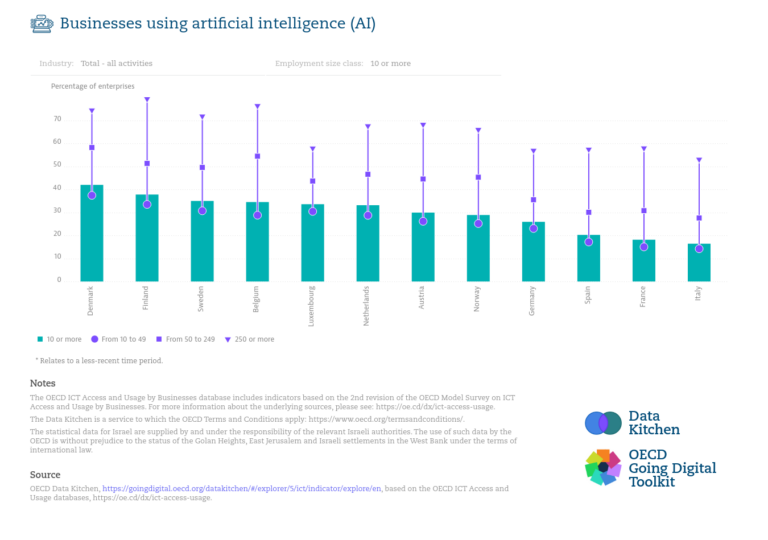
Abbildung 1: KI-Nutzen in Unternehmen im Vergleich, in Anlehnung an OECD Going Digital Toolkit 2025
Why the Nordics are faster
The reasons for these differences are structural – and cultural. For years, Nordic countries have been systematically investing in digital skills and further training. At the same time, they benefit from efficient infrastructure and close links between the state, the business sector and the education system.1
Added to this is a crucial difference in mindset. An analysis by ECIPE sums it up succinctly:
The power of innovation lies in its adoption, not its creation.1
Whilst Germany is strong in research and development, the Nordics consistently focus on implementation, scaling and market penetration.
Practical applications: Public administration and industry & manufacturing
This difference is particularly evident in the public sector. In countries such as Denmark, the use of artificial intelligence is already much more widespread: citizens’ enquiries are processed automatically and digital administrative processes are supported.2, 8
Germany, by contrast, is taking a much more cautious approach. Here, artificial intelligence is often used only in isolated cases, for example in the form of simple chatbots or for internal process optimisation. Data protection concerns and fragmented IT structures are holding back wider adoption. This trend is also reflected in the data from the Global AI Index: in the area of digital connectivity, Germany continues to lag behind Denmark, Sweden and Finland.5
A similar picture emerges in industry. Nordic companies are making targeted use of AI to optimise production processes, predict maintenance cycles and manage supply chains more efficiently. Iterative approaches and rapid implementation are the norm.9
In contrast, Germany focuses heavily on technological refinement – for example, in quality assurance through image recognition. However, many projects remain at the pilot stage and are only slowly being rolled out into regular operations, rather than launching initial practical trials with MVPs.
Regulation: both a strength and a challenge
Another difference lies in the approach to regulation. Germany relies heavily on legal and ethical frameworks, such as those set out in the GDPR and the EU AI Act. These foster trust and legal certainty, but can also slow down innovation processes.
The Nordic countries are subject to the same regulatory requirements as the EU AI Act, but apply them in a far more pragmatic manner. Rather than viewing regulation primarily as a risk, it is actively integrated into innovation processes there – for example, through close cooperation between the state, industry and regulators, as well as through the early application of new technologies under real-world conditions.1
The challenge for Germany therefore lies less in additional rules and more in how to deal with existing requirements. Instruments such as so-called ‘regulatory sandboxes’ can bridge this gap by creating protected spaces for innovation and test environments.10
Productivity follows usage
The economic impact is measurable. A study by Oxford Economics (2026) shows that regions with higher levels of AI usage tend to experience stronger productivity growth.11 At the same time, it is clear that the bottleneck no longer lies in the technology itself. Many companies already have initial AI applications in place – but use them in isolation, without adapting their organisation accordingly.
This shifts the key focus: what matters is not where AI is deployed, but how deeply it is integrated into value creation and decision-making processes.
What Germany must do now
To ensure we do not fall behind, three areas of action are particularly crucial:
- Accelerate adoption: Pilot projects must be scaled up more quickly and transitioned into routine operation
- Improve access to data: The framework for data usage must be simplified
- Use regulation strategically: Position trustworthy AI as a hallmark of German quality
Conclusion: From a land of strategy to a land of application
Germany has a strong foundation – in research, talent and industrial expertise. Yet a comparison with other European countries clearly shows that these strengths only realise their full potential through consistent application. The Nordic countries demonstrate how openness, speed and pragmatic implementation create competitive advantages.1, 9
The real challenge for Germany therefore lies not in the development of new technologies, but in their widespread and secure use, as well as in the technological openness of those who apply them.
One thing is certain: the future of AI will be decided where it is deployed in a targeted and efficient manner.
-
1. ECIPE - European Centre for International Political Economy (2025): Boosting AI in Europe: Follow the Nordics
-
2. Bitkom (o. J.): Digitalisierung im EU-Vergleich - Deutschland auf Platz 14
-
3. European Commission (2025): EU-Bericht zur Digitalisierung: Deutschland führend bei Spitzentechnologien
-
4. Mindsquare (o. J.): KI-Adoption: Definition und Bedeutung für Unternehmen
-
5. Tortoise Media (o. J.): Global AI Index
-
6. WIK - Wissenschaftliches Institut für Infrastruktur und Kommunikationsdienste (2025): Künstliche Intelligenz im EU-Vergleich: Einflussfaktoren und Potenziale (Nr. 537)
-
7. OECD (o. J.): Going Digital Toolkit - ICT Indicators / AI Adoption
-
8. Solita (2026): How AI is Transforming Nordic Work Life
-
9. t3n (2026): Warum der Norden KI schneller umsetzt als der Rest Europas
-
10. European Union (o. J.): AI Act - Regulatory Sandbox Approaches in EU Member States
-
11. Oxford Economics (2026): The North–South Regional Divide in AI Adoption