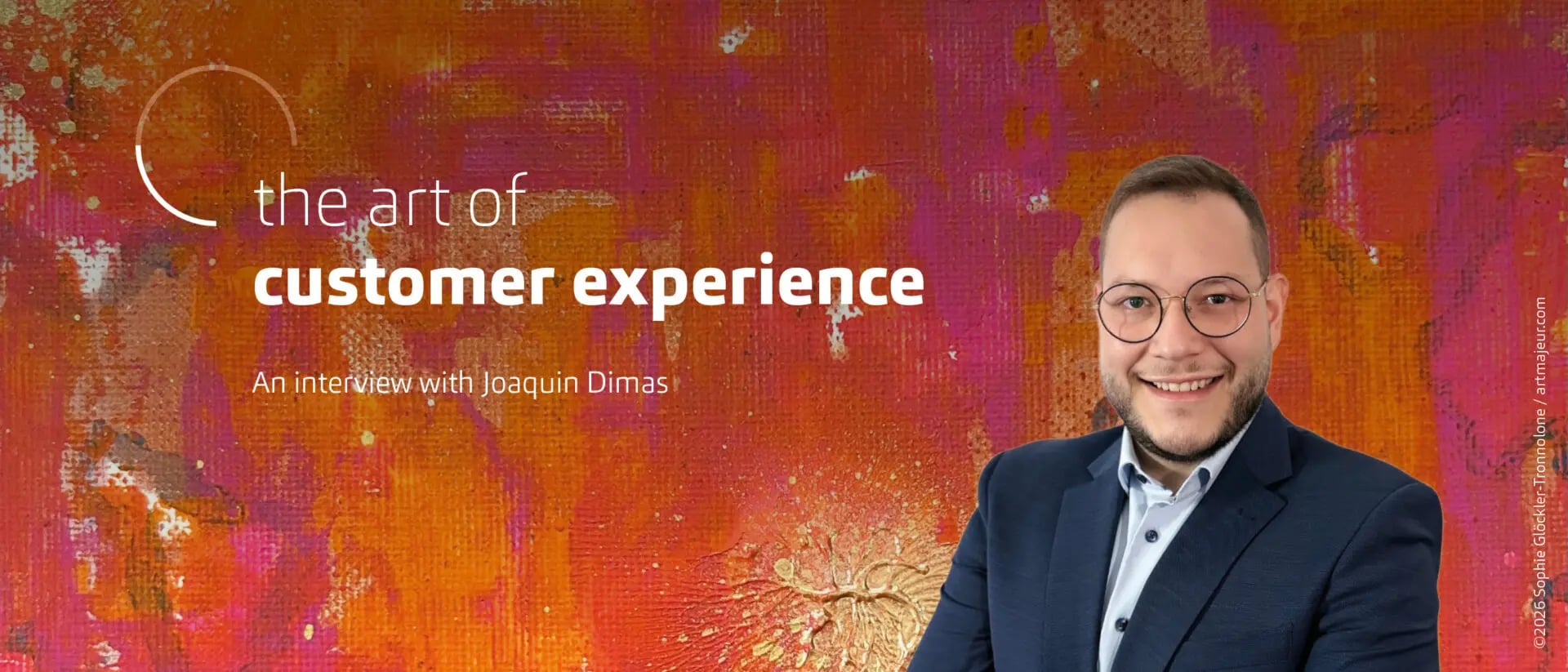




Interview with Joaquin Dimas, expert & senior consultant for customer experience, msg for banking ag
We spoke with Joaquin Dimas, Senior IT Consultant for customer experience at msg for banking, about the art of modern banking and why art and customer experience are such a natural fit.
Customer Experience is often associated with technology, automation, and efficiency. Where do creativity and emotion come into play, especially in banking?
(Joaquin Dimas) JD: I think, CX in banking is often viewed through a functional lens: better KPIs, fewer clicks, faster processes, more automation. And of course, that matters.
But if we stop there, we reduce banking to a transaction machine. And banking is more than that. It accompanies people in moments that carry real weight: financing a home, planning for the future, dealing with uncertainty, or making important financial decisions.
Creativity in CX means designing for the moment that actually matters, not just for the next process step.
Joaquin DimasSenior IT Consultant, msg for banking ag
That’s where creativity comes in for me. Not in the sense of making things prettier. It’s more about designing for the moment that actually matters to the customer, instead of just the next process step. Technology can make things faster. But deciding which moment deserves that attention, that’s a human, creative call.
We chose shades of red as a colour code for Customer Experience. Shades of red stand for activity, energy, and seamless interaction. What does that mean in practical terms for the design of meaningful customer journeys and digital experiences?
JD: I like “activity and energy” as a metaphor because CX is not static. It is movement, interaction, and adaptation. But in practice, these concepts do not mean more notifications, a louder design or a modern frontend.
For a bank, it means that context moves with the customer. If someone switches from the app to a phone call, the conversation should not start from zero. The advisor should understand what happened, what the customer needs, and what the next useful step is.
That is what seamless really means: channels, data, processes, and people moving together around the customer.
Where do banking customer journeys today still feel too functional, fragmented, or internally driven and where is fresh thinking most needed?
JD: Many banks are still organized around products, departments, and channels. Customers, however, experience banking through situations: buying a home, solving a problem, getting advice, or reacting to a life event.
That mismatch is where journeys become fragmented.
Fresh thinking is needed especially in the moments where this becomes visible: onboarding, advisory preparation, service requests, complaints, life-event communications, handovers between channels, etc.
For me, the real question is not only how to improve a touchpoint. It is: who owns the experience end to end? Many journey problems are not design problems. They are ownership and operating model problems.
Many banks are investing heavily in AI and automation. Can technology alone create meaningful customer experiences or does the human factor become even more important in the art of designing customer journeys?
JD: Technology alone cannot create meaningful experiences. It can create speed, scale, consistency, and better decision support. But meaning comes from context.
AI can be extremely valuable in banking: identifying needs earlier, supporting advisors, automating routine interactions, and making service more proactive. But only if the foundation is solid: reliable data, clear processes, and people who trust the system.
If that foundation is weak, AI does not fix CX. It can make existing problems louder and faster.
That is why the human factor becomes more important, not less. Someone still needs to decide where speed is the right answer, where a real conversation matters, and where automation creates distance instead of reducing friction.
AI raises the bar for CX thinking. It does not replace it.
Technology alone can't create meaningful experiences. AI raises the bar for CX thinking. It does not replace it.
Joaquin DimasSenior IT Consultant, msg for banking ag
How can banks transform customer journeys from purely functional interactions into experiences that truly create trust, relevance, and differentiation?
JD: I do not see trust, relevance, and differentiation as separate goals. They build on each other.
Trust comes first. It is built through consistency: the bank doing what it said it would do, when it said it would do it.Then comes relevance. That means understanding the customer’s context and using data responsibly at the right moment, in the right channel, with the right interaction. Most banks already have plenty of data. The hard part is connecting it meaningfully enough to create real value.
Most banks already have plenty of data. The hard part is connecting it meaningfully enough to create real value.
Joaquin DimasSenior IT Consultant, msg for banking ag
Differentiation comes after that. It becomes credible when trust and relevance are already working.
This is where a platform like BSI Customer Suite can play an important role: connecting customer data, journeys, campaign logic, service interactions, and process logic so CX becomes executable, not just conceptual. But the platform alone does not define the experience. The value comes when technology, business understanding, implementation discipline, and ownership work together.
Customer Experience becomes valuable when it works beyond the concept.
What can banks learn from creative industries about making complex experiences intuitive, memorable, and human, without losing the reliability and trust that banking requires?
JD: I think the main lesson is not aesthetics. It is intentionality.
Creative industries are good at designing attention, rhythm, emotion, and memory. They understand that people do not only remember what happened. They remember how clearly they were guided and how the experience made them feel.
Banking can learn from that, but this does not only mean it should become playful or colorful. Banking deals with risk, regulation, personal data, and important life decisions. The goal is not to make banking entertaining. The goal is to make it more understandable, continuous, and human.
One useful idea is to think in arcs, not only transactions. What happens before and after a key customer moment? Does the relationship continue with intent, or does the bank disappear until the next campaign?
Many banks have already mapped customer journeys and invested in digital channels. Why do these journeys still often fail in practice?
JD: Because a journey map is not yet a journey. A lot of conceptual work is often done well. Touchpoints are documented, pain points are mapped, platforms are live. But the real test starts after go-live, when the journey has to work with real customers, real employees, real data, real processes, and real exceptions.
Journeys fail when ownership is unclear, systems are not connected, or employees lack the context they need. For example, a service employee may have the right script but not the interaction history that would make the conversation useful.
The customer feels this without knowing exactly why. They simply sense that the bank is not quite connected.
That gap has a name: operational readiness.
The art is not only designing the journey on paper. The art is making it deliverable, meaningful, and human in practice.

the art of modern banking
Just as art translates complex ideas into a powerful visual language, banks must redesign their systems, processes and customer journeys – making them intuitive, transparent and consistently user-centric. Whether AI, the digital euro, cross-border payments or regulatory requirements – the real challenge does not lie in the technology itself, but in how it is designed, communicated and experienced.
Our conviction is clear: Creative minds. Powerful banking.