
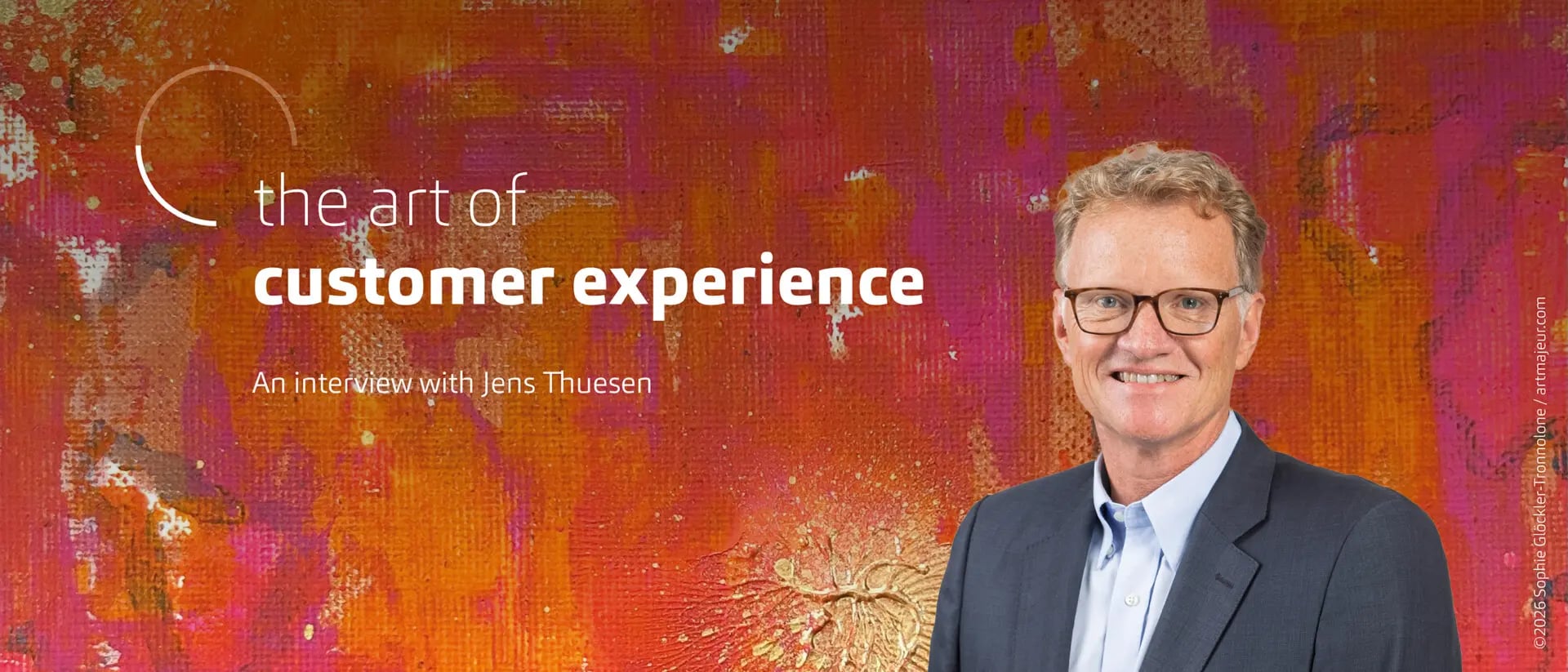





Interview with Jens Thuesen, Founder and Member of the Board of Directors, BSI Software

Jens Thuesen is co-founder of BSI Software. For three decades, he has shaped its development from a CRM pioneer into a leading European provider of Customer Relationship and Customer Experience solutions. With extensive experience across industries and markets, he has a deep understanding of customer-centric software and business transformation. Today, he focuses on business development and the responsible use of AI. Jens Thuesen also serves on the Board of Directors of BSI Software. With 660 employees, BSI Software is one of Europe’s leading providers of CRM and CX software and, with its AI-native BSI Customer Suite, is a market leader in its focus industries across the DACH region.
We spoke to Jens Thuesen about „the art of modern customer experience“ and why art and customer experience go so well together.
Customer Experience is often associated with technology, automation, and efficiency. Where do creativity and emotion come into play, especially in banking?
Jens Thuesen (JT): Banking has always been built on trust. Technology can make banking faster, cheaper and more convenient, but trust is never created by efficiency alone.
Creativity starts with asking a different question. Instead of asking „How do we automate another process?“, banks should ask „How do we make every interaction feel relevant?“
The emotional side of banking appears in life’s defining moments: buying a first home, starting a business, planning retirement or helping a family member after a difficult event. Customers rarely remember a perfectly executed transaction. They remember how their bank made them feel during moments that mattered
AI and automation have an important role here: Not because they replace people, but because they remove repetitive work that prevents people from focusing on customers. The real opportunity is not greater efficiency alone. It is creating more space for meaningful conversations, trusted advice and stronger customer relationships. That is how AI becomes a driver of growth, not just productivity.
Technology enables those experiences. Empathy, context and good design create them.
People rarely remember efficient interactions. They remember the ones that felt meaningful.
Jens ThuesenFounder, BSI Software
We chose shades of red as a colour code for Customer Experience. Shades of red stand for activity, energy, and seamless interaction. What does that mean in practical terms for the design of meaningful customer journeys and digital experiences?
JT: Red represents energy, emotion, and passion. Great customer journeys begin with a passionate mindset: genuinely caring about the customer. If you truly put the customer first, you naturally start asking different questions. Instead of asking, „Which process should the customer follow?“ but „How can we make this moment as easy and relevant as possible?“
For me, a modern customer journey should feel almost invisible. Customers should never have to explain themselves twice. They should never wonder which department they are talking to. The institution should understand the customer’s context, remember the relationship, and respond naturally.
In that sense, customer experience is an act of design. When it works, nobody notices the complexity or strategy behind it.
Where do banking customer journeys today still feel too functional, fragmented, or internally driven and where is fresh thinking most needed?
JT: Many banks have digitised touchpoints rather than relationships.
Customers move seamlessly between mobile apps, advisors, contact centres and online channels. Internally, however, those interactions are often still organised around products, departments and legacy systems. Customers experience one relationship. Some companies still operate dozens of disconnected processes. Closing that gap is probably one of the biggest opportunities in banking today. AI Agents can finally orchestrate many of these fragmented processes in the background. That means employees spend less time navigating internal complexity and more time helping customers make better decisions.
Many banks are investing heavily in AI and automation. Can technology alone create meaningful customer experiences or does the human factor become even more important in the art of designing customer journeys?
JT: AI is becoming extraordinarily good at analysing information and supporting decisions. However, customer experience is about making the right decision in the right context. AI without customer context simply becomes a sophisticated chatbot. AI with a complete understanding of the customer, previous interactions, preferences, products and ongoing processes becomes something entirely different: an intelligent relationship partner. Technology therefore becomes more important than ever.
Paradoxically, that also makes the human factor more important than ever. AI provides speed, consistency and intelligence. People provide empathy, judgement, creativity and trust.
The future isn’t AI instead of humans. It’s AI putting humans back in front of humans. That is where human-AI co-working creates the greatest value for customers.
The future isn't AI instead of humans. It's AI putting humans back in front of humans. That is where human-AI co-working creates the greatest value for customers.
Jens ThuesenFounder, BSI Software
How can banks transform customer journeys from purely functional interactions into experiences that truly create trust, relevance, and differentiation?
JT: I believe we need to move beyond thinking in isolated customer journeys. Once you start thinking in Customer Values, individual journeys become part of a much bigger picture.
The question is no longer, „How do we design the account opening journey?“ Instead, it becomes, „What matters most to this customer, and how can we continuously create value around that?“
Customer journeys then become expressions of a relationship rather than isolated processes. Every interaction contributes to the same goal: strengthening the relationship by creating value whenever it matters.
Growth follows naturally from that approach. Customers who feel understood buy more, stay longer and recommend their bank more often. AI helps scale those relationships … but people make them meaningful.
We need to move beyond thinking in isolated customer journeys.
Jens ThuesenFounder, BSI Software
What can banks learn from creative industries about making complex experiences intuitive, memorable, and human, without losing the reliability and trust that banking requires?
JT: Artists rarely start with the obvious solution. They observe and simplify until only what truly matters remains. Banks, however, sometimes do the opposite. They keep adding products, options and processes. Real innovation is usually based on subtraction and focus rather than addition. Great artists know that every brushstroke has a purpose. Great customer experiences follow the same principle.
Creative industries also understand something very important: consistency creates identity. Every interaction contributes to the overall experience of a company’s brand. Banks should think the same way.
Many banks have already mapped customer journeys and invested in digital channels. Why do these journeys still often fail in practice?
JT: I actually see many banks succeeding with end-to-end customer journeys today. That has been a major achievement over the past years. But I also believe we’re entering the next stage. Instead of thinking primarily in customer journeys, we should start thinking in Customer Values.
The key question is „What creates the most value for this customer in this specific situation?“
That perspective becomes even more important in the age of AI Agents. The quality of their recommendations will depend less on predefined journeys and more on their ability to recognize what creates value for the customer in a given situation.
That also changes the role of employees. As AI Agents increasingly handle routine coordination and repetitive activities, people can focus on coaching, advising and solving the situations where human understanding makes the biggest difference. In that sense, AI doesn’t reduce the importance of people, it amplifies it.
Perhaps that’s the true art of customer experience: not designing the perfect journey but continuously creating value throughout the relationship.

the art of modern banking
Just as art translates complex ideas into a powerful visual language, banks must redesign their systems, processes and customer journeys – making them intuitive, transparent and consistently user-centric. Whether AI, the digital euro, cross-border payments or regulatory requirements – the real challenge does not lie in the technology itself, but in how it is designed, communicated and experienced.
Our conviction is clear: Creative minds. Powerful banking.