Data Driven Gets You Compliant, Data Inspired Gets You Ahead: Why Data-Driven Steering Isn’t Enough
Data-driven is regarded as one of the guiding concepts of digital transformation. Organisations that base decisions on data rather than intuition are seen as modern, rational and competitive. This premise is correct and, at the same time, incomplete. Whoever consistently implements data-driven approaches has laid the foundation to steer existing processes in a measurable, consistent and compliant way. However, they have not yet answered the question of how new value creation arises under uncertainty - value that cannot necessarily be derived from extrapolating existing data. This is precisely where "data-inspired" comes in.
This article differentiates the two approaches conceptually, shows why data-inspired is not merely a further development of data-driven, and then looks, by way of example, at whether and how this can be applied to the situation of banks in Germany.


What distinguishes data driven from data inspired?
Data driven: steering through evidence
Data driven optimises existing processes, answers defined questions, aims at efficiency, and uses data as a steering instrument.
Data-driven decision-making refers to a process in which courses of action are systematically assessed and selected on the basis of existing, structured data – as distinct from decision-making based primarily on intuition.¹ It is characterised by a closed feedback loop: data is collected, aggregated, converted into key figures, and serves as the basis for decisions whose effects are, in turn, measured and fed back into the system.
Data-driven approaches are characterised by the following features:
- Historical orientation: The data basis describes what has happened or is currently happening. Forecasts extrapolate from historical patterns.
- Optimisation logic: The goal is to improve existing processes, products or key figures within an already defined framework (efficiency, accuracy, compliance).
- Reproducibility: Decisions should be traceable, auditable and, ideally, capable of being automated.
Data-driven competence is thus, at its core, an ability to control, consolidate and optimise processes: it ensures that an organisation knows what is going on within it, and that it continually improves existing workflows on the basis of this knowledge. In the management literature, this capability is also described as a competitive factor in its own right, one that allows organisations to distinguish themselves from competitors through the systematic evaluation of their data.²
Data inspired: from interpretation to impulse
Data-inspired questions whether the right processes exist, poses new questions drawn from the data material, aims at meaning and coherence, and uses data as a source of institutional insight.
Data inspired does not use data primarily to confirm or optimise existing assumptions, but as a starting point for questions, hypotheses and ideas. Here, data is understood less as evidence than as a stimulus for thought – a distinction that is explicitly set apart in the practitioner literature from a purely confirmatory, data-driven approach.³
Characteristic features include:
- Exploratory character: The focus is not on confirming a known hypothesis, but on discovering unexpected patterns or contradictions in the data – a distinction that can be traced methodologically back to the contrast between exploratory and confirmatory data analysis.⁴
- Combination and contextualisation: Data inspired frequently links company data with heterogeneous, incomplete or unstructured data sources, such as external knowledge, market observations or qualitative findings.
- Openness to the future: The goal is not to reproduce the status quo, but to generate new options – for example, new products, business models or a changed understanding of customers – data-based but not predetermined.
Data-inspired competence is, at its core, an ability to interpret and generate ideas: it enables an organisation to derive additional meaning from data that goes beyond what is already known.
Summary comparison
| Dimension | Data Driven | Data Inspired |
| Time orientation | Past/present | Future-oriented |
| Steering function | Control | Impetus/basis for ideas |
| Logic | Deductive, confirmatory | Abductive, exploratory |
| Quality of results | Measurable, reproducible | Plausible, but uncertain |
| Organisational location | Reporting, corporate steering, process optimisation | Innovation, strategy, product development |
This comparison suggests that these are not two levels of maturity on the same scale, but two different models for handling data.
Why data inspired is not merely a further development of data driven
Data inspired is often presented as the “next maturity stage” after data driven – in effect, the crowning achievement of a linear data-maturity staircase. But that is only part of the truth.
Different error logic
Data-driven systems are designed to interpret data. Data inspired, by contrast, aims to test hypotheses and ideas - and, where necessary, to discard them again.
An idea that emerges from such “inspiring” data analysis and later proves untenable is a regular, even necessary, part of the process of gaining insight. An organisation’s ability to work with falsifiable, provisional findings cannot be produced by refining existing data-driven processes; it requires a new mindset.
Different data requirements
Data-driven systems depend on structured, complete, quality-assured data. Incomplete or inconsistent data is rightly regarded as a deficiency. Data inspired, on the other hand, derives its value from combining high-quality data with incomplete, heterogeneous or informal data sources — for example, dialogues, market assessments, competitor observations or free-text fields. Data inspired thus builds, in part, on the data infrastructure that data driven creates, but supplements it with additional, often external, data sources that are mostly unstructured. This calls for expanded organisational and architectural concepts.
Different organisational anchoring
Data-driven competencies are typically anchored in reporting, risk and controlling functions, which are optimised for standardisation, traceability and repeatability. Data-inspired competencies, by contrast, tend to develop in innovation, strategy or product functions, whose success criterion is not conformity but novelty. Deepening one system does not automatically produce the other. Both require independent investment in processes, roles and culture.
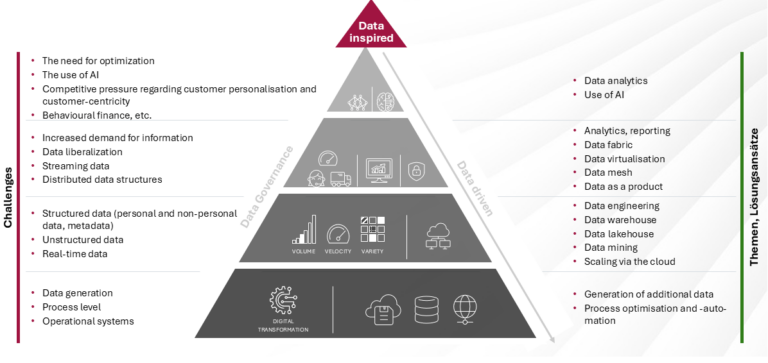
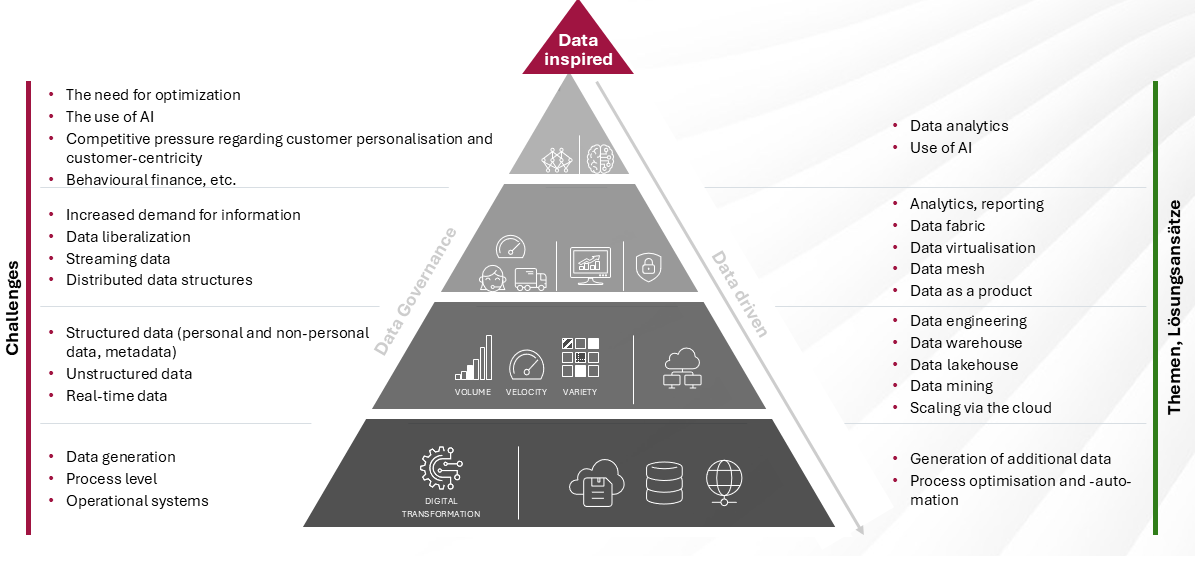
Figure 1: Data-inspired – The challenges of digitalisation open up opportunities for data-centred solutions (click on the image to enlarge)
Interim conclusion
Data inspired builds on the data infrastructure that data driven creates. Without robust, integrated data, there can be no serious exploration. In this sense, a dependency exists. However, this dependency is not a maturity-level relationship but a foundational one: data driven supplies the infrastructure, while data inspired requires an additional, independent capacity for interpretation — one that comes with different tools, different error cultures, and different organisational and architectural structures. “Data driven is the baseline, data inspired is the edge” captures the relationship more accurately than a staircase metaphor: the mandatory element is a prerequisite, but it does not, by itself, produce the discretionary one.
How can the baseline gets you ahead, when it comes to banks
The German banking landscape is particularly well suited to illustrating this distinction, as it appears to be at different stages of development along both dimensions.
Data driven as a regulatory standard
German banks — and credit institutions across Europe more generally — are subject to a regulatory framework that all but forces data-driven capabilities. Requirements such as BCBS 239 (Principles for effective risk data aggregation and risk reporting), published by the Basel Committee on Banking Supervision,⁷ MaRisk (Minimum Requirements for Risk Management) issued by BaFin,⁸ or DORA (the Digital Operational Resilience Act, Regulation (EU) 2022/2554)⁹ demand consistent, complete, timely and auditable data aggregation. In recent years, institutions have made substantial investments in data governance, data quality management and lineage capabilities in order to meet these requirements.
Data driven, in the banking sector, is not a strategic option but a regulatory precondition for conducting business.
Driving innovation with data inspired
Regulatory-driven excellence in data governance — for instance, as part of BCBS 239 implementation or metadata management – is a necessary but not a sufficient condition for data-based innovative capacity. Institutions that have consistently built up their data-driven infrastructure have a valuable starting point. Whether this translates into data-inspired value, however, depends on further choices – such as deliberately carving out space for exploratory data work, and embedding this organizationally so that innovation functions get genuine data access and the freedom to act on it.
Conclusion
Data driven and data inspired address different questions: one, how an organisation acts in a controlled and compliant manner on the basis of existing knowledge; the other, how it generates new knowledge and new options from data. Both capabilities are complementary but not interchangeable. Data inspired does not arise automatically from deepening data driven; it requires independent investment in error culture, data diversity and organisational anchoring.
The banking landscape illustrates this distinction particularly clearly: regulatory requirements have, in many respects, led to a high degree of data-driven maturity, while data-inspired practices — at least in public presentation — appear underdeveloped.
For institutions seeking to secure their data-based competitiveness in the long term, this implies the need to fulfil data driven as a mandatory requirement, without neglecting the discretionary pursuit of data-based innovation capability.

Data inspired banking – data-based creativity shapes the future of banks
Further information on data-inspired banking can be found on our website.
What is data driven?
Data driven refers to an approach in which decisions are made systematically on the basis of existing, mostly historical data, typically through reporting, KPIs and rule-based analyses. The focus is on efficiency, control and the confirmation of known relationships (confirmatory).
What is data inspired?
Data inspired describes an open-ended, exploratory approach to data, in which new questions, patterns and business ideas are discovered, rather than merely testing existing assumptions. The approach is future-oriented and serves primarily innovation, not operational steering.
Can data driven and data inspired be used synonymously?
No. They describe different logics (confirmatory vs. exploratory) and purposes (efficiency/mandatory vs. innovation/discretionary), and should be kept conceptually distinct.
Is data analytics the same as data inspired?
No. Data analytics is the overarching methodological toolbox (statistics, ML, visualisation) that can serve both data-driven and data-inspired purposes. Data inspired is thus a particular way of applying data analytics, and is not identical to it.
Is data driven the same as process automation?
No, but the two are closely related: process automation is often a use case or outcome of data-driven approaches, not their definition. Data driven is the broader decision-logic framework from which automation follows as one possible implementation.
Sources
-
1. Provost, F., Fawcett, T., Data Science for Business. O'Reilly Media, 2013, Vgl. auch die Definition datengetriebener Entscheidungsfindung als Abgrenzung zu intuitionsbasierten Entscheidungen.
-
2. Davenport, T. H., Harris, J. G., Competing on Analytics: The New Science of Winning. Harvard Business School Press, 2007; Davenport, T. H., Competing on Analytics. Harvard Business Review, 84(1), 98–107., 2006
-
3. Vgl. die Abgrenzung von data informed, data driven und data inspired in der Praxisliteratur, u. a. Go Practice, Data-driven, data-informed, and data-inspired product decisions. What are the differences and when should you use each one?, September 20212
-
4. Zur Unterscheidung von explorativer und konfirmatorischer Datenanalyse vgl. Fayyad, U., Piatetsky-Shapiro, G., Smyth, P., From Data Mining to Knowledge Discovery in Databases. AI Magazine, 17(3). , 1996
-
5. March, J. G., Exploration and Exploitation in Organizational Learning. Organization Science, 2(1), 71–87, 1991
-
6. Vgl. die Gegenüberstellung von datengetriebener und geschäftsgetriebener KI-Strategie, u. a. hinsichtlich der Grenzen explorativer Datenanalyse gegenüber systematischer, datenqualitätsorientierter Analyse. In: Building AI Innovation Labs together with Companies, arXiv:2203.08465.
-
7. Basel Committee on Banking Supervision, Principles for effective risk data aggregation and risk reporting (BCBS 239). Bank for International Settlements, 2013
-
8. Bundesanstalt für Finanzdienstleistungsaufsicht (BaFin). Rundschreiben 06/2024 (BA) – Mindestanforderungen an das Risikomanagement (MaRisk), 29. Mai 2024
-
9. Verordnung (EU) 2022/2554 des Europäischen Parlaments und des Rates über die digitale operationale Resilienz im Finanzsektor (Digital Operational Resilience Act – DORA), 14. Dezember 2022