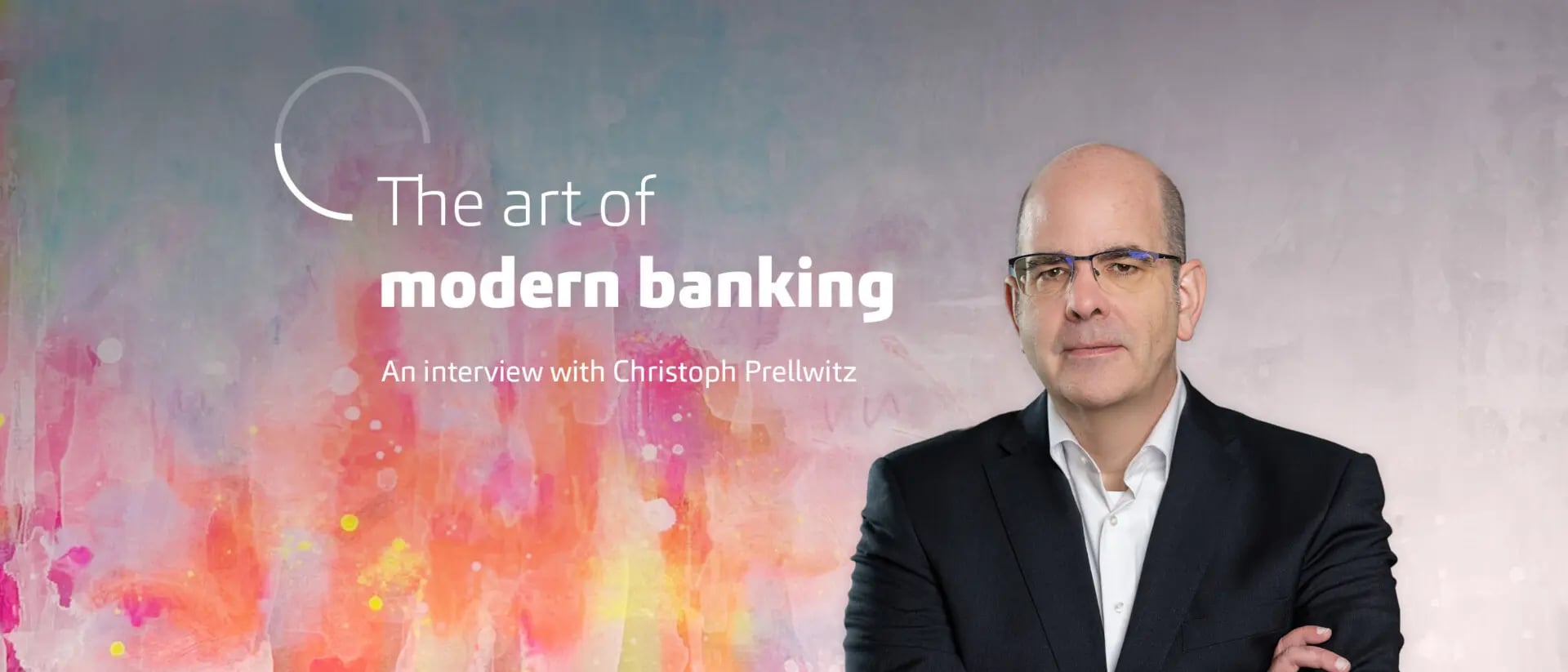

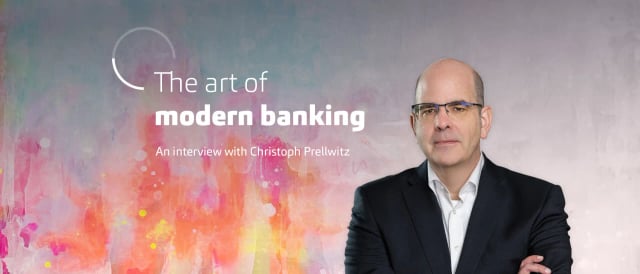
Art is a human story. So is money.
Somewhere between numismatics and Stanley Kubrick, this conversation grew into something much bigger than payments. Markus Nenninger leads one of the most forward-looking teams inside msg for banking, working on payments, the digital euro, and what comes after both. The conversation ranges from 4,000-year-old coins to AI agents that may one day pay each other, and keeps landing, from several different directions, on the same idea: that payments, like art, has always been something people make for other people.
A colour built for stability
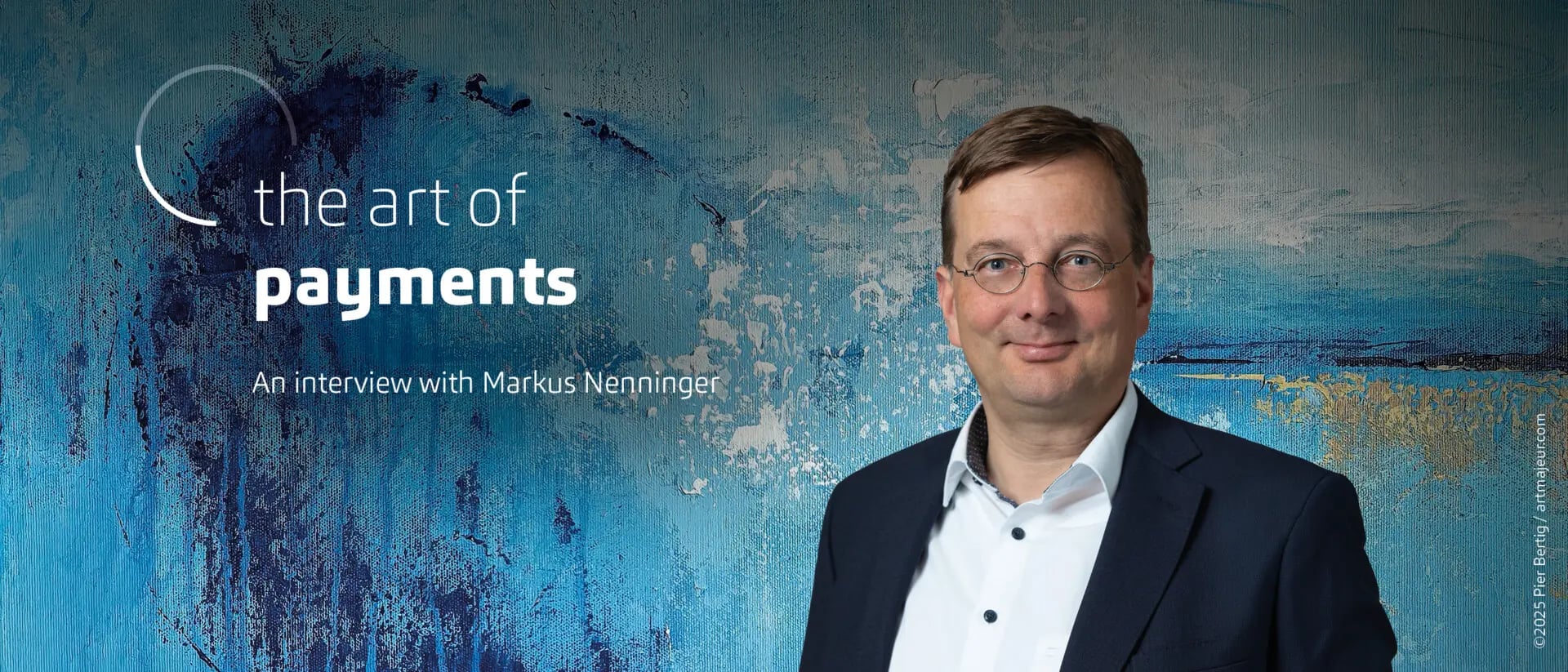
In the visual world of this campaign, Payments is blue — chosen for security, professionalism, reliability. It’s a fitting place to start, because Markus’s own description of the field pulls in both directions at once.
Stability is the whole point. Payments is about money getting from A to B safely, quickly and cheaply. Everything else follows from a world that keeps changing around that one job.
Markus NenningerHead of Payments, msg for banking ag
“Everything else” is doing a lot of work in that sentence. A new cross-border payment provider now turns up roughly every month — Markus was packing for Sibos in Miami the following week, where, he said, the sheer number of competing providers is striking. Blue, in other words, isn’t the absence of movement. It’s what the movement is supposed to add up to.
Money was always Pop Art
Asked what first came to mind when he heard his own team’s work folded into a campaign called “the art of modern banking,” Markus didn’t hesitate: a relief, he said — his day-to-day work is IT-heavy and often dry, built for one half of the brain. He liked that the campaign made room for the other half.
Asked whether payments work is really dry, or secretly creative — closer to standing in front of a blank canvas, deciding where the first big brushstrokes go — he answered with history rather than a straight yes or no.
Money has always been Pop Art. Coins were minted artistically for a very practical reason — it made them harder to fake. And that same minting process reproduced them endlessly, put them in everyone’s hands. That’s Pop Art in its most original form, long before anyone called it that.
Markus NenningerHead of Payments, msg for banking ag
It’s a neat echo of something Dirk Findeisen said earlier in this series about Warhol and scale — except here, the link between art and the subject at hand isn’t a metaphor at all. It’s just payments history.
Four thousand years of milestones
If money is pushing 4,000 years old, art might be older still — cave paintings are probably humanity’s first attempt to make an idea permanent. With that in mind, Mathis asked for the two or three biggest turning points across payments’ own history. Markus didn’t treat it as a small question, and didn’t rush the answer.
“The first real breakthrough was the invention of money itself,” Markus said — independently in China and in Asia Minor, where Lydia is generally credited with the first coinage, though Markus also pointed to the old legend of King Midas and his golden touch, tied to the same region. “The next was the invention of giro accounts in Renaissance-era Italy, which made book money possible for the first time.” After that came paper money, finally breaking the link between a currency’s value and the material it was made of — though the gold standard kept a shadow of that link alive for a long time afterwards.
“Money might be humanity’s most successful intellectual invention,” he said. “I’d go that far.”
Find out more about "the art of modern banking"
What agentic payments actually means
The conversation’s most forward-looking turn came by way of a term Markus introduced himself: agentic payments. His reasoning starts one level up, with the economy as a whole.
We’re only just seeing the beginning of an agentic economy. And an agentic economy can’t function without agentic payments.
Markus NenningerHead of Payments, msg for banking ag
Mathis asked about the mechanics – do AI agents pay each other directly, and could an agent ever hold money of its own – he was careful to separate what’s technically interesting from what’s still, at bottom, a legal question.
“As far as we can tell today – and this is also a legal question – the money will always belong to some person, or at least some legal entity,” Markus said. “Unless agents themselves become legal persons one day, which could still happen. For now, whoever equips an agent with money and gives it a mandate remains the owner. The agent acts on that authority, transacting with other agents who are acting on someone else’s authority in turn.”
Which payment methods end up suiting agents best – and which don’t – is still an open question, he added. Cash, for obvious reasons, is not a strong candidate.
Craft now, art later
There’s a distinction in how people talk about art — craft on one side, art on the other — that Mathis floated as a way of separating the destination from the next few steps: if the still-unknown future of payments (which actor moves which currency, how, and on what rails) is the eventual masterwork, what are the more modest, craft-like steps banks need to take to get there — the equivalent of learning a new technique before attempting the next large canvas?
“The real challenge — for banks and everyone else in the payments ecosystem — is the sheer pace and complexity of change,” Markus said. “Take cross-border payments: there used to be essentially one way to do it, through SWIFT. Now there’s a new variant, a new provider, almost every month.”
Banks, in his view, sit in the middle of that complexity by necessity, not by choice.
“Banks have to be the connective tissue between what customers need and what’s newly possible,” he said. “The job is to keep the overview, understand the customer, match that to what the market offers, orchestrate it properly — and then package and deliver it so simply that the customer barely notices. Banks have to master the complexity and hide it, both at once.”
Banks have to master the complexity and hide it, both at once.
Markus NenningerHead of Payments, msg for banking ag
Hiding the work behind the work
Mathis asked, around this point, which art form speaks to him personally, Markus picked film — for a reason that has nothing to do with the screen.
“Film is one of the only art forms that’s genuinely built by a team,” he said. “There’s no film made by one person alone.” His favourite director: Stanley Kubrick — “perfectionist, visionary and philosopher, all at once. A good combination.”
That idea — a result so seamless you forget how many people built it — is exactly what reminded Mathis of Walt Disney, who spent a career pushing the technical limits of animation (synchronised sound, Technicolor, the first feature-length cel-animated film) while still needing to produce something that worked for a mass audience. These days, that same instinct for pushing technical boundaries lives mainly at Pixar — which Disney bought outright in 2006, and which has operated ever since as its own studio inside the Disney family. Markus agreed the analogy holds.
You don’t see the work behind any good work of art.
Markus NenningerHead of Payments, msg for banking ag
“You don’t see the work behind any good work of art,” Markus said. “You just see a fascinating result, and can only guess how much effort went into it. It’s exactly the same with payments. It has to be simple, convenient, secure and global — without anyone thinking about it. Behind that, there are thousands of people making it possible.”
One concrete example of that invisible engineering: msg for banking handled the implementation of a Verification of Payee solution — sold and operated by Netcetera — now live at more than 40 banks across Europe and, by Markus’s account, the market leader among German private banks. It runs, he said, reliably, and measurably improves payment security.
The team as the masterpiece
Mathis asked for the biggest “masterstroke” his team had pulled off in the last year or two — the thing he’s proudest of — Markus didn’t point to a product.
“The real masterpiece is the team itself,” he said. “What I’m proudest of is the energy I feel when I talk to my colleagues about this work — how much they care, how creative and engaged they are, how they see themselves as part of something bigger. And how they treat each other: like a real team, generous with their time and their help. That’s the biggest thing.”
Returning to the film-crew idea from earlier, Mathis asked what the equivalent “roles” look like inside a payments team.
“We’re set up a lot like a film crew,” Markus said. “Some colleagues are the screenwriters — they develop the subject matter, build know-how, run trainings, publish, do the thought leadership. Others are the camera — making sure the film actually runs for the client, delivering the projects. And then there are the people selling the tickets, so to speak, handling the rights — going to clients and making sure the film actually reaches an audience.”
What Germany and the Nordics can still learn from each other
On where to look for inspiration internationally, Markus didn’t hesitate between the two directions Mathis offered — he took both.
“The Nordics are a step ahead — not just in payments, but in digitalisation generally,” he said. “Day-to-day life there is simply more digital. Almost half of all payments in Germany are still made in cash; in the Nordics, it’s down to a small percentage.”
“Where we have an edge is the backend — the ‘rails,’ as we call them,” he said. “The Eurosystem started modernising its infrastructure relatively early, and it shows: some of the most modern rails in the world. The Nordics still have some modernisation ahead of them there, and our experience from the Eurosystem’s own migration — ISO 20022, for the specialists — travels well.”
ISO 20022 is the messaging standard payments are gradually migrating to worldwide — unglamorous, but the kind of infrastructure work most of this conversation is actually about.
Until the agents arrive
Mathis asked if there was anything else close to his heart on “the art of modern payments,” Markus returned to the point he’d been circling all along.
Payments is made by people, for people. That’s not going to change. Art is made by people, for people, too — which makes payments a kind of art in its own right.
Markus NenningerHead of Payments, msg for banking ag
Mathis asked, half-joking, whether that holds even once the agents arrive, he didn’t miss a beat: “Then we’d call it agentic art.” Where the guardrails will actually sit — what gets left to the agents, and what doesn’t — is a live question with no settled answer yet. But Markus left the last word somewhere else entirely.
“Art,” he said, “is ultimately a human narrative. And so is money.”
For payments leaders: what to take from this
- Stability is the job, complexity is the environment. Payments still comes down to moving money safely, quickly and cheaply. But a new cross-border provider or variant now appears almost every month, so the real challenge is the pace and complexity of change, not any single technology.
- Banks win by mastering complexity and hiding it. Their role is to be the connective tissue between customer needs and what’s newly possible: keep the overview, match offers to needs, orchestrate them, and deliver them so simply that customers barely notice.
- Agentic payments need attention now. An agentic economy can’t function without them. For the moment, money remains with a person or legal entity, and the agent acts on a mandate. Open questions such as legal ownership, mandates, guardrails and which payment methods suit agents are worth working through before they become urgent.
Curious what else msg for banking is building in payments, the digital euro and beyond? Find out more on our homepage.