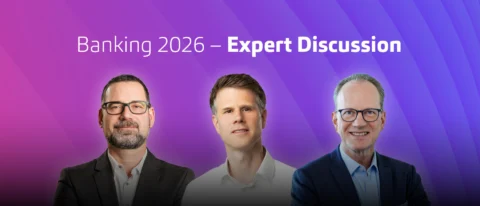
Banking 2026 – challenges and opportunities, II
| Part 2 |
The year 2025 was also challenging for banks. What can they expect in 2026? We discussed this with our experts Andreas Mach, Rainer Wilken, and Stefan Baumann. In the second part of our three-part expert discussion “Banking 2026,” we discuss the skills shortage in banks, the changing corporate culture, and the continuing geopolitical volatility.

Included in this collection:
Open collection
Fit and Proper as a Executive Manager: What KWG, BaFin and MaRisk require – and what actually counts in practice

Decide – Delegate – Focus: How Managers become the number one factor for success
Operational resilience, regulatory resilience and digital competitiveness in the financial services sector

Important items on the Executive Board agenda at the start of 2026

Banking 2026 - Challenges and opportunities, III
Banking 2026 - challenges and opportunities, II
Banking 2026 - challenges and opportunities, I

Shortage of skilled workers in banking: strategies for board level

Mastering transformation risks – people as the decisive factor for success
Banking in 2026: Skills shortage, corporate culture, and the volatile geopolitical situation
The year 2025 was challenging in many ways, including for banks. What does 2026 hold in store for banks? We discussed this with Andreas Mach, member of the Executive Board, Rainer Wilken, Head of Management & Business Consulting, and Stefan Baumann, Head of Management Consulting.
In the second part of our three-part expert discussion “Banking 2026,” we discuss the skills shortage in banks, the changing corporate culture, and the continuing highly volatile geopolitical situation.
The questions are asked by Andrea Späth and Karin Dohmann.
By the way: At msg for banking, we are on first-name terms across all hierarchies and maintain this approach in our interviews with colleagues.
Skills shortage: There will always be many areas where people work with people.
Welcome to the second part of our expert discussion, Andreas, Rainer and Stefan. Today we would like to talk to you about an aspect that is regularly discussed: the skills shortage in banking. Do you see artificial intelligence as the answer to this?

Stefan Baumann: “AI is part of the answer, but not the whole answer. There will always be areas where people work with people. Especially when it comes to risk weighting and related considerations, as well as decisions with far-reaching consequences, for example in strategy. AI will not take this work away from people in banking in the coming years. Especially since many customers do not want major decisions to be made automatically.
In my opinion, the issue of skills shortages remains acute despite the use of AI.
Stefan Baumann Division Manager Management Consulting
AI can be used to make certain processes more efficient or shorter, meaning that fewer employees are needed. Many banks are already planning for this. But the future of banking will lie in a hybrid structure, i.e., a structure in which people and technology work together.
In my opinion, the issue of skilled labor shortages remains acute despite the use of AI. Studies show that there are currently 35,000 to 40,000 unfilled positions advertised in banks. Banks need to address this issue, and they have several levers at their disposal.
First, of course, they can deploy their employees more efficiently. And then they can develop them for more demanding work and coach them. Another crucial component is retaining employees and offering them a modern working model and attractive development opportunities. Young people in particular naturally want to know how they can develop within the bank. And then, of course, it is also important to build new skills early on, especially in the areas of technology and IT. This is an area in which many banks simply do not have enough young talent, so they need to take care of training at an early stage.”

Current blog post
Shortage of skilled workers in banking: strategies for board level
by Gerhard Baumann, Stefan Baumann
and Dr. Philippe Krahnhof

Andreas Mach: “AI can also increase the attractiveness of jobs. After all, being a specialist means that you have expertise in a subject area – and if the AI performs simple, perhaps even dull tasks, the specialists can focus on the interesting, interpretative and more exciting topics. AI can then certainly be an auxiliary tool to make jobs in banks more attractive again and to attract skilled workers.”
Rainer Wilken: “There will also be skills shortage in the future because university graduates who decide to go into banking will no longer be able to go through trainee programmes where they have to keep Excel lists and prepare presentations. The “machine” has been doing this for a long time. This means that banks need to think carefully about how to introduce young people to the banking profession in the future. They need to offer additional, new training programmes and take on some of the tasks of the universities. And thus train specialists that they can then deploy.”
Banks need to think carefully about how they introduce young people to the banking profession in the future.
Rainer Wilken Business Unit Manager Management & Business Consulting
The topic of corporate culture and modern leadership is closely linked to the issue of skilled labour and skills shortages. How do you see the situation?

Rainer Wilken: “In conversations with customers, I keep hearing that the issue of changing culture and leadership has been with banks for some time. And this will become even more acute in the coming years, the keyword being ageing. The average age in banks and savings banks is high and when the boomers retire, there will be a huge loss of knowledge. On the other hand, older teams are often not very diverse, are considered less innovative and have grown up with a different error culture – this will have to change in the future.

(Click on the graphic for the event)
But believing that you can simply hire young talent doesn’t work either. That’s because young people today often have other plans and are not interested in finance or banking. They want meaning, flat hierarchies, and a great deal of flexibility; they want to work agilely, with AI, and remotely. But many banks simply cannot offer that to the extent that young people want.
That’s why staff turnover is particularly high among young employees. After two years, they often say, “Okay, I’ve seen everything there is to see, now I’m moving on.” Banks need to address this issue and become much more flexible.”
Stefan Baumann: “I recently discussed this topic with a cooperative bank. The explicit focus was on training managers to make the corporate culture significantly more agile. Banks must be prepared to make adjustments in this area, take their employees with them, and offer them modern working opportunities. This will also be an issue they will have to work on in 2026.”
If we look at the current volatile geopolitical situation, we see an increase in geopolitical risks. Therefore, the ECB wants to test banks' resilience to political risks in 2026. What does this mean from your perspective? How do banks need to prepare for this? Or are they already well prepared?
Andreas Mach: “Measuring resilience is a term that has been very much in focus at banks in recent months. Among other things, it stems from the Digital Operational Resilience Act (DORA), an important and relatively new regulatory requirement, but of course also from the current geopolitical difficulties. Essentially, banks need to consider how they are positioned against these risks at the end of the day, whether they can measure them, how they can integrate them and what strategies they can use to ward them off.
Measuring resilience is a term that has been very much in the spotlight at banks in recent months.
Andreas Mach Member of the Executive Board
This starts with external cyber attacks and ends with the geopolitical question of whether the data is even secure where it is stored.
There are various options here that now need to be explored – from European clouds to providers that operate exclusively in Germany to solutions that primarily aim to make everything available locally and in a highly protected, private space.
All these elements are important because the ECB will naturally want to know in its stress tests whether and how the solutions are comparable. Where there are differences in performance, which security aspects need to be taken into account.
The ECB stress test will, of course, initially affect the major institutions. Nevertheless, the individual requirements will also be relevant for smaller and medium-sized banks, albeit in a different form. But everyone will have to prepare for this – rethinking their entire data management system, developing emergency plans, and becoming aware of how to ward off external attacks.
Today, we still find it very difficult to measure such risks, integrate them into normal risk management, and ensure consistency with existing risk management practices. Taking the next steps in 2026 will be a major challenge.”
Rainer Wilken: “Returning to geopolitical risks: the major banks are involved in Asia, the Baltic states, South Africa, and other places where things could potentially go wrong at some point. We need to keep an eye on this in the future and develop scenarios and options for action today in case supply chain disruptions or payment defaults occur tomorrow. This applies to all aspects of risk management and internal processes. Banks need to be prepared for this and establish a robust crisis management system.
However, savings banks and cooperative banks would be affected more indirectly, in terms of monetary policy and the economy, as they have little or no exposure in these countries.”
Our experts
Andreas Mach, member of the Executive Board, is responsible for Sales and Marketing and for the Management & Business Consulting divisions. He has also worked for many years as an author, speaker, consultant and expert in the fields of bank management, risk management, controlling, regulation, compliance, analytics and artificial intelligence.
Rainer Wilken, Business Unit Manager Management & Business Consulting, has extensive experience in the development and expansion of consulting business for financial services, business development, sales management and customer support as well as comprehensive expertise in the transformation of banking organisations. His focus is on strategic transformation and technology-driven business models.
Stefan Baumann, Division Manager Management Consulting, has more than 20 years of experience in the banking and financial sector. He supports banks with strategic issues relating to business development and optimisation – from mergers, board changes and business model adjustments to organisational development and the use of modern technologies in the operating model.