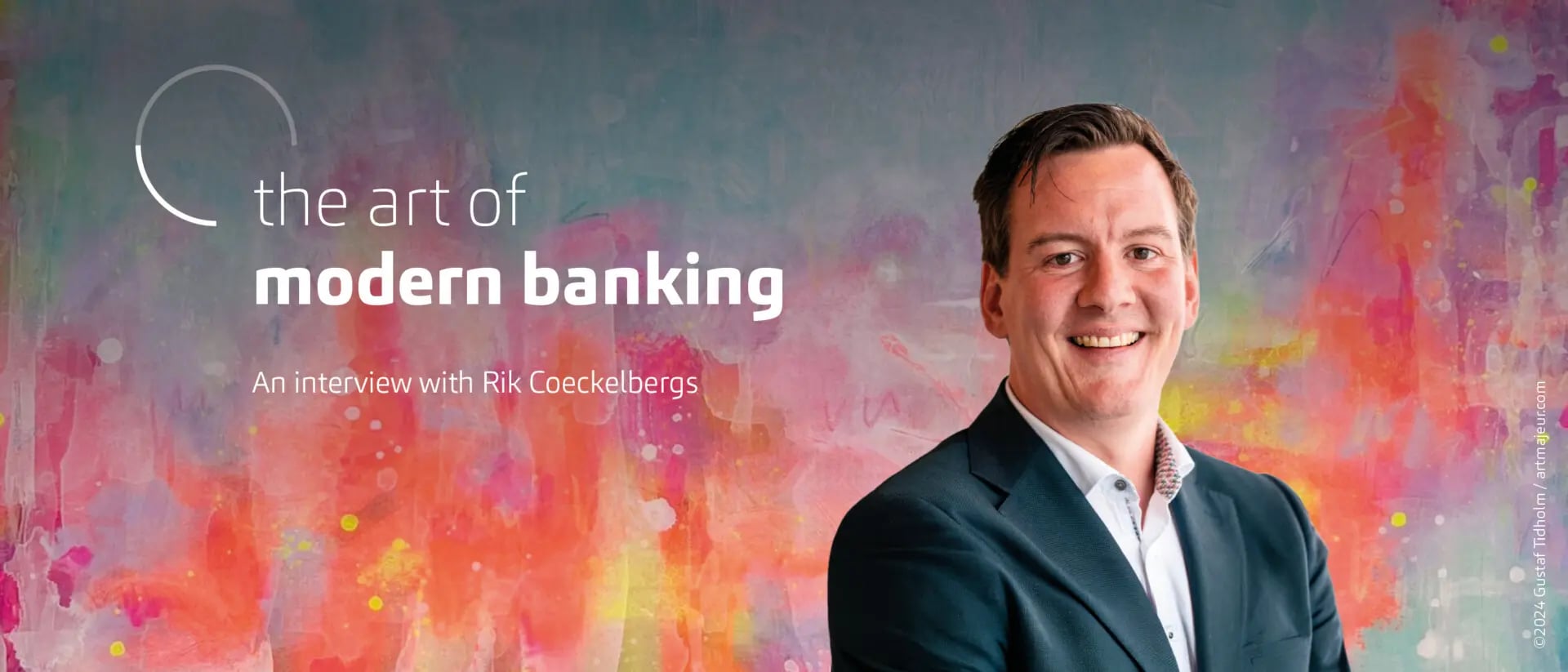
Interview with Rik Coeckelbergs, Founder and CEO of The Banking Scene
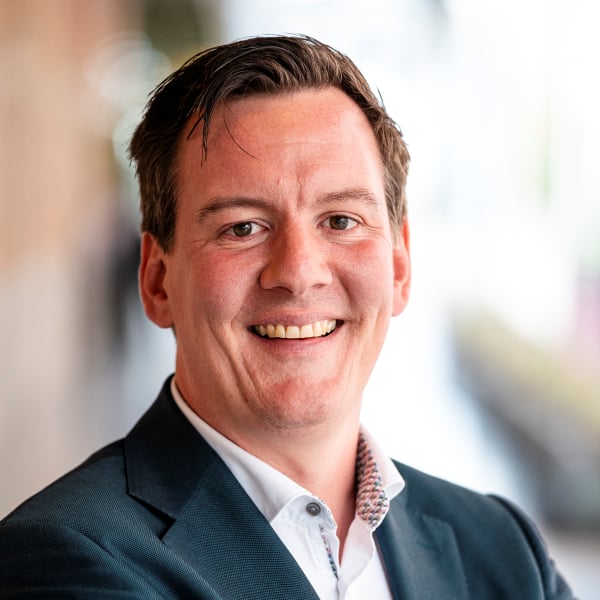
Rik Coeckelbergs is the Founder and CEO of The Banking Scene, a community that brings together banking professionals across the Benelux region through conferences, round tables and content. It grew out of “Innovations in Payments”, a LinkedIn group he started in 2009 that now counts more than 150,000 members. Alongside The Banking Scene, Rik works as an independent advisor and speaker, focusing on payments, retail banking and open finance.
How art can give banking a different way of seeing
Mathis Manz (MM): Courage, consistency, change. Anyone who has built something lasting in banking knows these three words. Few realise how much they share with the people who make art.
Rik Coeckelbergs is a good test case. He is a banker by background and conviction, and the founder of The Banking Scene, which is celebrating its tenth anniversary. He rarely goes to museums, he does not consider himself an art person, and he would never call himself an artist. And yet he is preparing the sixth edition of an evening that brings bankers and art into the same room.
I come from the theatre. For ten years I acted, and my old director used to say that art lets people see things differently and more richly. By that measure, the question is not whether someone intends to be an artist. Those who set out to be one rarely are. Someone who never planned to can be.
I sat down with Rik to find out how a banker with no particular interest in art ended up doing something very close to it, and what that can do for banking. First, we discussed what it takes. Then, what it gives.
The venue came first
The Banking Art Night did not start with an idea about art. It started with the search for a room. Rik and his team wanted a museum as the setting, and by luck there was a temporary exhibition of David Hockney’s works from the COVID lockdown, made on a tablet. The theme followed the venue: how banks had changed during the pandemic.
“It was more about COVID and how banks adapted than about art,” Rik said. “Several things came together, and we decided to call it the Banking Art Night. It worked, so we kept the formula and changed the art every year.”
By his own account, that first edition was still fairly straightforward: as many bank executives from the C-suite as possible, talking about how they had changed the art of banking. Nothing yet suggested what the evening would become.
It echoes a point Dirk Findeisen made earlier in this series: art, in the sense that matters here, is not about intention but about capability. Rik did not set out to make art. He built something that works like it.
Courage
Rik started The Banking Scene as a side project while working at a bank, out of passion for banking rather than for organising events. After two years of doing both, he left the bank to build it full time. Then COVID arrived and took his revenue with it.
“I had a business that suddenly I no longer had, and a solution had to be found,” Rik said.
Within about a month, The Banking Scene was running small digital rooms every Thursday afternoon, from four to five, each with a special guest and open to everyone as equals. Usually between ten and twenty people joined, including quite a few CEOs. The rooms earned little money, but they built the reputation of The Banking Scene and Rik’s own skills as a moderator. A few partners helped it survive. He is proud to have needed government support for only half a year.
Rik makes the link himself when he describes what entrepreneurship asks of you.
“You open yourself up and show what you stand for,” Rik said. “And if you do that well, you want it to be perfect, just like an artist who makes something.”
I agree: in both, you hand your work over to the judgement of others. Making something is probably not the hard part, Rik added. Showing it is. “I’m not an artist myself, but I can imagine that this would be the toughest part of being an artist, because it makes you vulnerable.”
I recognised it from the stage. The hardest roles were those closest to myself, with everything on display, including what I usually try to hide. For me, that kind of courage comes with a holy discontent: never being satisfied unless it is perfect, and knowing that it never will be. Does it get easier?
“Absolutely,” Rik said. “It is a process of growing confidence, and of peace of mind.”
The stress, he explained, came from wanting every expectation to be met. “Realising that you can’t keep everyone happy all the time was a very tough lesson.” These days he sometimes worries about the opposite: that he feels too comfortable. What gives him energy are the conversations rather than the events themselves. Talking to executives across the market, he says, is a kind of masterclass in banking.
Consistency
Courage gets you started and growing. Consistency keeps you recognisable. For Rik, virtual and physical events are two different things, and he keeps them apart: no hybrid. As soon as it was possible, The Banking Scene went back to physical events, but it never gave up on digital. For one year after COVID, he ran his five events and the weekly online roundtables, plus a blog about them. He is just as consistent about the Art Night itself, which has been a fixed part of The Banking Scene’s year since the first edition and returns for the sixth time this December.
If something has worked, build on top of it instead of starting over.
Rik CoeckelbergsFounder and CEO at The Banking Scene
“It was a lot of work,” Rik said, “but that is how The Banking Scene became what it is today. If something has worked, build on top of it instead of starting over.”
I called it consistency, and added that the most famous artists rarely repeat themselves yet stay true to their core. You can always tell it is their handwriting. Rik agreed.
“They have a brand,” he said. “You need an identity and a brand. If you don’t have that, how can people find you?”
What stays the same, in other words, is the formula and the identity. What changes is the art.
Find out more about "the art of modern banking"
A different art every year
After Hockney, the first Art Night, came an exhibition on ancient Alexandria, which pushed the conversation into more uncomfortable territory: how do you make sure you are a mirror of the society you serve? Then came opera and brainwaves, then a Dutch cartographer’s painting of how money flows through society, and last year an AI video that turned the room into a spaceship. This year the evening takes place at KANAL – Centre Pompidou in Brussels.
This year’s programme is built around the journeys of the people on stage, or the organisations they represent, and Rik points to two of them. Amana Finance is building an Islamic bank in Brussels. Venly had to rebuild after the NFT market it was founded around disappeared: at its peak the company had 55 people, today it has eight, with the technology intact but a different organisation. That is change without losing what you are built on.
Seeing things differently, and more richly
Courage, consistency and change explain how Rik keeps the evening going. What it gives the people in the room is another matter. Back to the definition of my old director: art lets people see things differently and more richly.
If that is the test, what does the Art Night do to the people who attend? Rik’s answer starts with a change of frame.
“Ask someone to talk about the do’s and don’ts of AI, and you get one story,” Rik said. “Ask them about the art of AI in banking, and you get a completely different one. Simply by adding art, people think differently and look at different aspects of the topic.”
The clearest example was the third Art Night, Opera and Brainwaves, on the theme of augmented empathy. Instead of asking about the potential of AI, the question was how technology could bring empathy back between a bank and its customers. Paired with an opera singer in a dress that changed colour with her brainwaves, it produced, in Rik’s words, completely different ideas.
“It is about bringing people into another box,” he said. “It is also more enjoyable and more experiential, so people remember it for longer.”
Whether banks acted on it is hard to say. Rik’s answer is “probably”. He points to proactive digital assistants such as KBC’s Kate, which does not wait to be asked, and to banks using AI against fraud to help the customer rather than to streamline a process. Much more is possible, he argues, because banks still too often look at AI through an efficiency lens instead of an effectiveness lens.
Banks still too often look at AI through an efficiency lens instead of an effectiveness lens.
Rik CoeckelbergsFounder and CEO at The Banking Scene
One speaker at that evening, Ghela Boskovich, gave an example that stayed with him: a mortgage is not just a credit but a capability to buy a house, which stands for family, comfort and a safe haven. For the neighbourhood, owners tend to take better care of their homes than renters do; they stay longer and pay taxes that improve the environment. It becomes something much bigger than a product. Rik counts it among the most important messages of that evening.
Banks often forget this, Rik says, because they think in products. In his view, banks that see themselves purely as private, profit-seeking organisations do not always take it on board. Few admit that they are semi-public institutions, and fewer still act like it.
The most vivid example came last year. An AI video covered all four walls and the floor, so that the people in the room felt as if they were inside a spaceship. Bankers stood shoulder to shoulder and engaged with questions that rarely come up in a banking meeting.
“Full engagement,” Rik said. “People became part of the movie. You don’t see that at regular events, where people share content and have exhibitions. Such experiments are hard to organise, expensive, and need a very specific room.”
The video also raised tough questions about the future, among them which side of the equation you want to stand on when your children later ask about your responsibility for how it turned out.
Does the art really change the conversation? For last year’s edition, Rik has no doubt. “It depends on the edition,” he said, “but for last year it is definitely true.” The CEOs who told him the evenings forced them to reflect and step out of the obvious point the same way. That there is a sixth edition at all suggests the format has found its audience.
What banks can take from this
Why should any of this matter to a bank? This year’s Art Night asks what banking is becoming, and its own programme says that “Transformation is no longer a journey with a clear destination.” A question like that cannot be answered with a better plan, only with a different view. If there is no clear destination, the risk is no longer a wrong step but being overtaken. What remains is capability.
Rik’s story points to three things, each backed by what he did rather than what he said.
Act before you are certain.
When COVID removed his business, it took about a month to build the Thursday rooms. Nobody knew whether they would work.
Know what you never change.
The formula stays, the art changes. The Banking Scene is recognisable because of what it refuses to give up, not because everything stays the same.
Help people see differently, not just inform them.
The do’s and don’ts of AI produce one conversation, the art of AI another. A mortgage as a credit is a product; a mortgage as a capability to buy a house is a purpose.
Rik is not planning big changes for The Banking Scene, only to keep delivering on what it stands for, especially in its tenth year. In Luxembourg the programme includes Chris Skinner, who explains how banking works through novels such as Diary of a Ponzi Scheme, a genre he calls Pulp Finction. Stories, again, as a way of seeing.
For himself, Rik prefers a different word than artist. He works with Andrew Vorster, Head of Growth at The Banking Scene, and the two have a name for what they do.
“Andrew and I always call ourselves storytellers more than event organisers,” Rik said. “So in that sense there is art involved, even though I’m not someone who regularly goes to a museum. It is a different kind of art.”
He calls himself a storyteller, not an artist. By the definition of my old director, the distinction may matter less than he thinks.
The Banking Scene Art Night 2026
See it for yourself: The Banking Scene Art Night takes place on 7 December 2026 at KANAL – Centre Pompidou in Brussels. Find out more at thebankingscene.com.
msg for banking is a sponsor of The Banking Scene Art Night 2026, and Mathis Manz is one of this year’s speakers. His session will be brought to life by Linda Boehm-Heckel, an artist who will stand next to Mathis on stage and visualise his talk’s content live on canvas, so the audience can watch the artwork emerge as he speaks.