












The talent shortage at cooperative banks is well documented. By 2032, around 30,000 employees will reach statutory retirement age.[1] 64 percent of staff have been with the same institution for more than a decade.[2] Both figures describe the same workforce: experienced, long-tenured, and set to retire in significant numbers in the foreseeable future.
The effect is not limited to regional banks. Large banks face the same situation in rural regions and specialist functions. For regional banks, though, it is more immediately existential, because personal advisory service is their key point of differentiation against direct banks and platform providers.
The war for talent is real, but it doesn’t answer the question
Competition for qualified staff has intensified. The labor market in financial services has shifted from a seller’s market to a buyer’s market.[3] Candidates now do the choosing, and institutions find themselves applying. This competition is decided less by the job posting itself than by the industry’s image and by actively approaching the right candidates. Open positions in the financial sector stay vacant for an average of 154 days.[3]
Employer branding and active sourcing are therefore right and necessary. But they answer a different question from the one at stake here. Even an institution that fills the vacancy successfully hasn’t filled the knowledge gap that comes with it. What tends to get overlooked is what actually disappears when a customer advisor with 25 years of experience leaves the bank.
What actually gets lost
An experienced corporate customer advisor carries knowledge that no file contains: which business owner is planning to hand over the company this year, which entrepreneur manages cash flow seasonally despite a solid balance sheet, which customer prefers a quick call over a written form. This is situational judgment built up over years and tied to individuals. When those individuals leave, the knowledge leaves with them.
The long average tenure of over a decade[2] shows just how much person-bound knowledge accumulates within an institution, and how much of it is put at risk with every departure. This isn’t only about retirement. Any rise in staff turnover hits trust, customer relationships, and ultimately advisory quality in the same way, just faster and harder to plan for. Joe, Yoong, and Patel confirm this from a research perspective: implicit knowledge held by experienced employees is especially hard to codify, yet it is decisive for advisory quality.[4] Without a structure that anchors it permanently within the organization, that knowledge is lost for good.
Knowledge retention as a customer experience issue
The loss of this knowledge has a direct effect on customer experience and customer loyalty.
A corporate customer whose advisor changes has to explain their situation all over again. Information the previous contact person knew without ever writing it down is no longer accessible. The advisory quality the customer associated with the institution was tied to a person, not to the bank itself.
The weight of this becomes clear in Atruvia’s 2024 study „Digitalisierung im Bankensektor“ (Digitalisation in the Banking Sector). Trust, at 41 percent, and personal advice, at 40 percent, are the two criteria customers cite most often when choosing their bank.[5] These are exactly the two factors put at risk when an advisor changes. Customers notice when their familiar contact is gone, and they start comparing. That makes knowledge retention a customer experience task, not just an HR one.
Documentation alone doesn’t solve the problem
The obvious response is more mandatory fields, more structured handover protocols, and knowledge databases. An AI-supported knowledge base can certainly contribute important building blocks, for example by turning unstructured notes into something the system can actually evaluate. But it doesn’t solve the problem on its own, because people don’t document what feels self-evident to them.
The real question is a different one: how do you design a working environment in which knowledge is created, stored, and passed on as a natural byproduct of daily work, so that successors can build on it from day one?
The answer lies in the process itself. Knowledge has to become part of the work, not an extra step afterward. Four elements form the foundation:
- A single, central view of the customer, rather than scattered personal notes and individual filing systems
- Documented interactions that arise naturally from the workflow, not ones that need to be maintained separately afterward
- Standardized advisory processes that capture relevant information in a structured way
- Traceable histories that show decisions and agreements in context
Modern CRM and CX platforms create exactly this foundation, by capturing customer knowledge systematically, linking it, and making it available in everyday work. The same architectural logic pays off on the regulatory side as well: bringing data, process, and governance together in a single layer delivers benefits on both fronts (link: „A European regulation-ready CRM as a success factor for modern banking in Europe“).
What this looks like in practice
One example of this approach is banking.X.hub, the BSI Customer Suite developed by msg for banking and preconfigured for the German banking market, with direct API integration to core banking systems such as agree21 for the cooperative financial group. It brings advisory, service, and sales together in a single digital workplace.
What matters here is less the individual feature than the interplay of processes, data, and user adoption. Three capabilities make this concrete in daily operations:
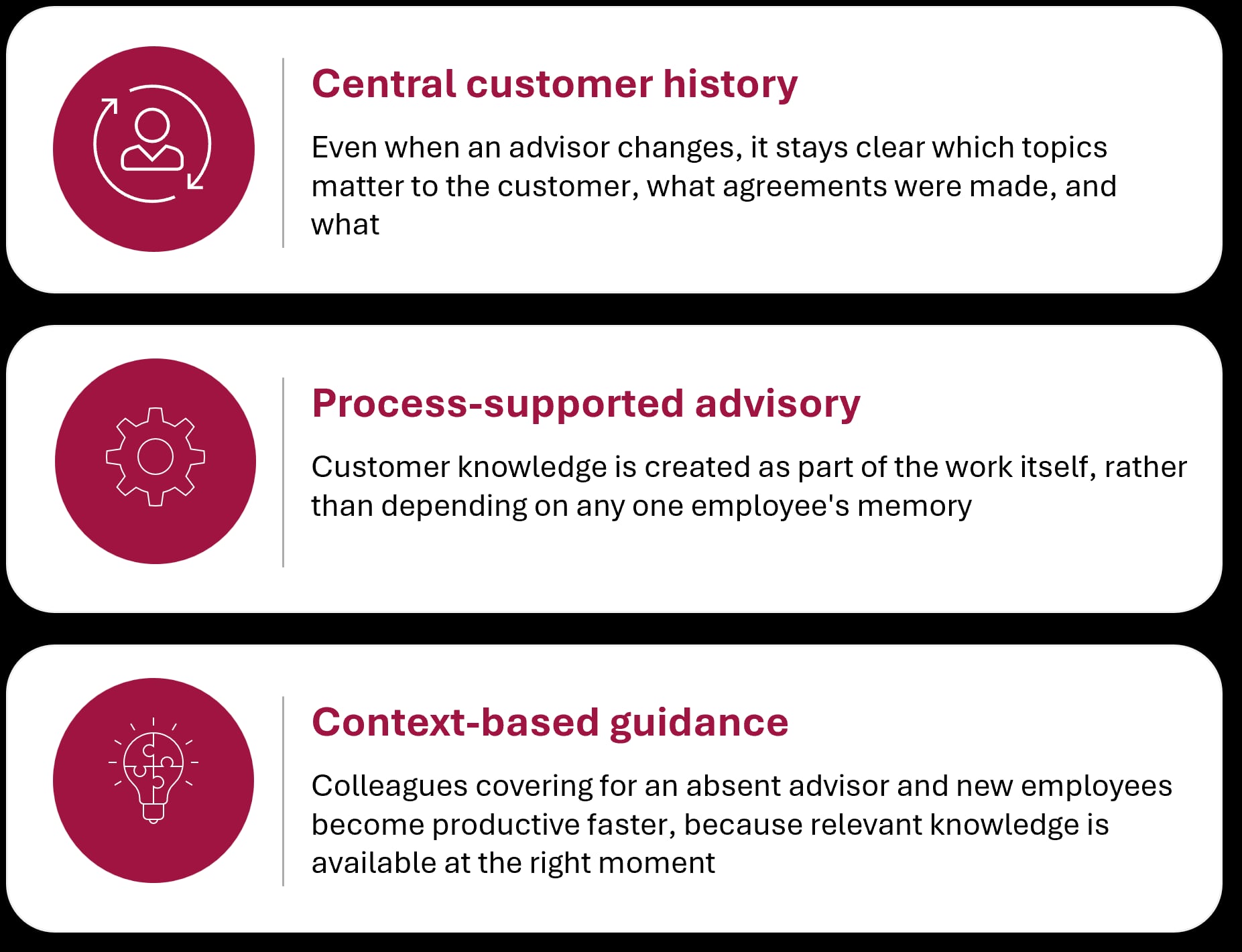
Integration with the core banking system is not a technical detail here; it is a precondition for adoption. Systems that bypass the existing core banking system don’t fail because of the technology; they fail because people stop using them. banking.X.hub was designed from the outset to fit into the existing IT landscape without parallel data storage and without forcing users to switch systems mid-process.
More on the BSI Customer Suite and banking.X.hub: Banking.X.hub
The strategic question for regional banks
Recruiting alone cannot solve the talent shortage. The demographic curve is set, the wave of retirements is predictable, and competition for talent will only get harder. What regional banks can influence is the structural resilience of their knowledge and process infrastructure.
The decisive question, then, isn’t how quickly an institution fills an open position. It’s how much of a customer relationship stays with the bank once the person who built it is gone. Institutions that have an answer to that today secure a real advantage. Their customers experience it directly, through trust, continuity, and advisory quality that hold up even when the person across the table changes.

Is your institution also facing an acute challenge from demographic change? Want to know how banking.X.hub secures customer knowledge in your institution for the long term?
Quellen
- 1. Christoph Fröhlich, „Deutschlands Regionalbanken: Die Tausend-Marke ist gefallen", dasinvestment.com, 2025.
- 2. Bundesverband der Deutschen Volksbanken und Raiffeisenbanken (BVR), Konsolidierter Jahresbericht 2024, 2025.
- 3. Thomas Hammer, Philippe Krahnhof, „Wege aus der ‚Bankerlosigkeit'", Springer, 2025.
- 4. Carmel Joe, Pak Yoong, Kapila Patel, „Knowledge loss when older experts leave knowledge-intensive organisations", Journal of Knowledge Management, Emerald, 2013.
- 5. Atruvia AG, „Digitalisierung im Bankensektor — Studie 2024", 2024