

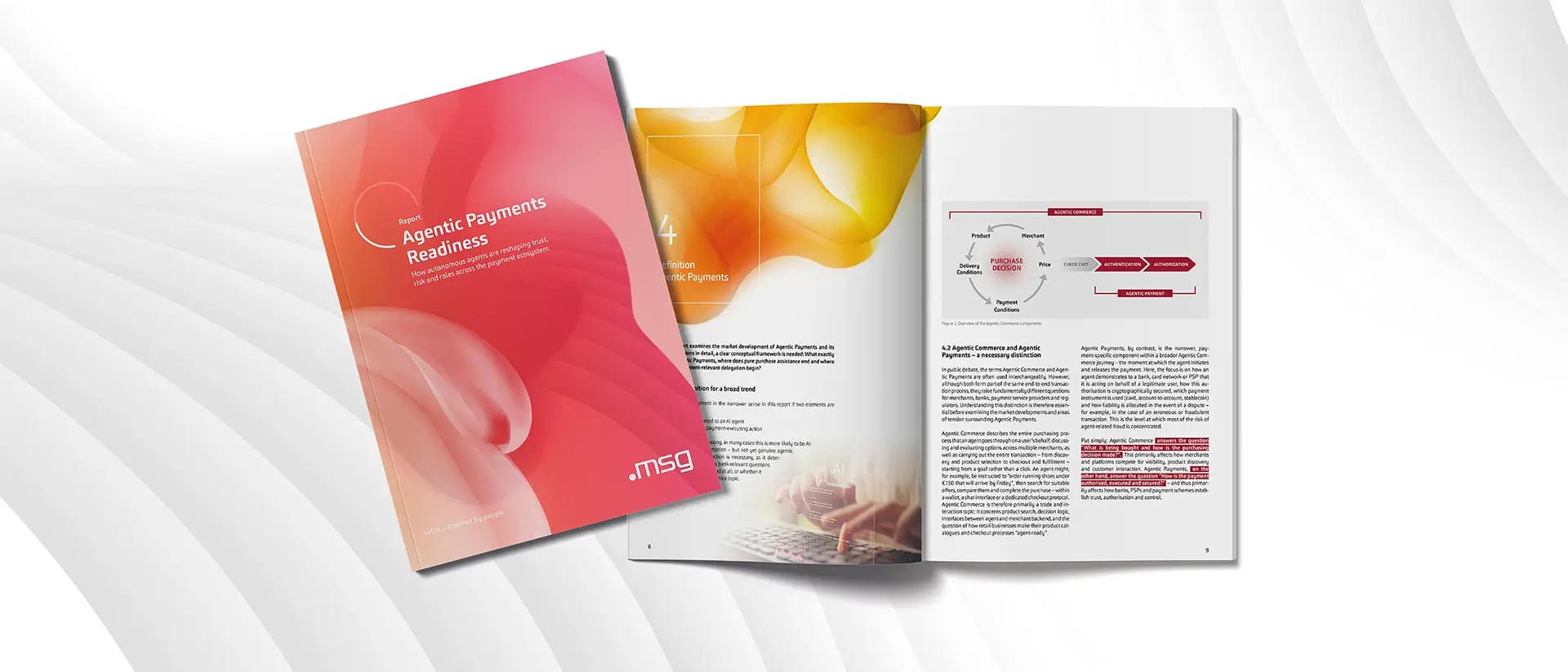









For decades, every payment ended with a human: a tap, a PIN, a glance at the camera. That era is slowly coming to an end. AI agents are beginning to choose, confirm and pay on our behalf and control structures, the payment ecosystem has relied on, no longer fit.
This report draws on an independent survey of 152 merchants across Germany, Austria and Switzerland, complemented by market, legal and regulatory analysis. It shows what changes, who is exposed, and what to do before agent-initiated payments scale.

Get the report
Agentic Payments: adoption is racing ahead of readiness
Within just a few months, virtually every major player, from card networks, Big Tech and payment platforms, has taken its first steps toward agent readiness. Our merchant survey shows the market has moved just as fast: more than 80% of respondents are already engaging with Agentic Payments, from initial evaluation to live piloting. Agentic Payments are no longer a distant vision.
But speed is not the same as readiness. The moment an agent moves money on someone’s behalf, familiar questions get harder: How does a bank or PSP know the agent is genuinely authorised? Who is liable when an agent buys the wrong thing or is tricked into it? And who, exactly, is responsible for making any of this trustworthy? This report follows those tensions through the whole ecosystem — and the answers from the market are not the ones most institutions would expect.
What you can expect from this report
- A workable definition and a four-level autonomy framework that tells banks and PSPs which agent payments actually raise authorisation, liability and fraud questions, and which are just commerce.
- Exclusive data from 152 senior payments decision-makers across the DACH region: how far merchants really are, what they expect their customers to fear, and what they want solved at industry level.
- The trust question, answered by the market: who merchants expect to make agent payments trustworthy.
- Where liability lands when an agent gets it wrong, and why the market has no shared answer yet.
- An independent legal perspective (Dr. Matthias Terlau, law firm Görg) on how PSD2’s strong-customer-authentication and dynamic-linking rules collide with pre-authorised agent mandates, and what PSD3/PSR will as well as won’t resolve.
- A guest perspective from valantic FSA on the operational reality that follows the agent’s “Pay”: proving an agent stayed inside its mandate, and handling exceptions and investigations inside the instant-payment clock.
- What shifts for each player (banks, merchants, PSPs/acquirers, schemes and AI platforms) including who risks losing visibility and who could own the emerging “trust layer”.
- Scenarios to 2030 and a concrete, per-actor strategic priorities you can take straight into your next strategy session.
Who should read this
Heads of payments, product and risk at banks and PSPs; acquirers and schemes defining their agent strategy; and senior payments and e-commerce decision-makers at merchants preparing for agentic commerce.
The report at a glance
Independent online survey of 152 senior payments decision-makers at DACH e-commerce merchants (Germany 102, Austria 25, Switzerland 25), each with online revenue above €1 million, across travel/OTA, groceries & CPG, fashion, consumer electronics, marketplace and ticketing. Fieldwork between June and July 2026, conducted by an independent market research institute. Complemented by independent legal and industry perspectives from Dr. Matthias Terlau (law firm Görg), Ulrich Binnebößel (German Retail Federation, HDE) and Christian Schwarz (valantic FSA).
The report at a glance
- Agentic Payments: the next transformation of trust in payments
- Executive summary
- Intro
- Definition – and the four levels of agent autonomy
- Current status – market, protocols, regulatory framework
- Central questions and areas of tension
- Implications for the payments ecosystem – roles, opportunities and challenges
- Need for action and outlook 2030

Read now
Outlook
Agentic Payments have left the realm of future scenarios: the pilots, the players, the first standards and real transactions already exist. The open question is no longer whether the technology arrives, but how fast it scales, and whether the ecosystem can build shared governance and trust at the same pace as its technical foundations. This report sets out where each actor stands today, and the concrete steps to shape that shift rather than merely react to it.
Agentic Payments are not a new payment system. They are a new layer of trust — and that layer is still up for grabs.
Karl-Günther IllingExecutive Partner, msg for banking
Talk to our experts
Beyond the findings in this report, the survey produced a range of further results. If you’d like a deeper dive into the full data set — or want to discuss what Agentic Payments mean for your organisation specifically — reach out to the msg for banking payments team.