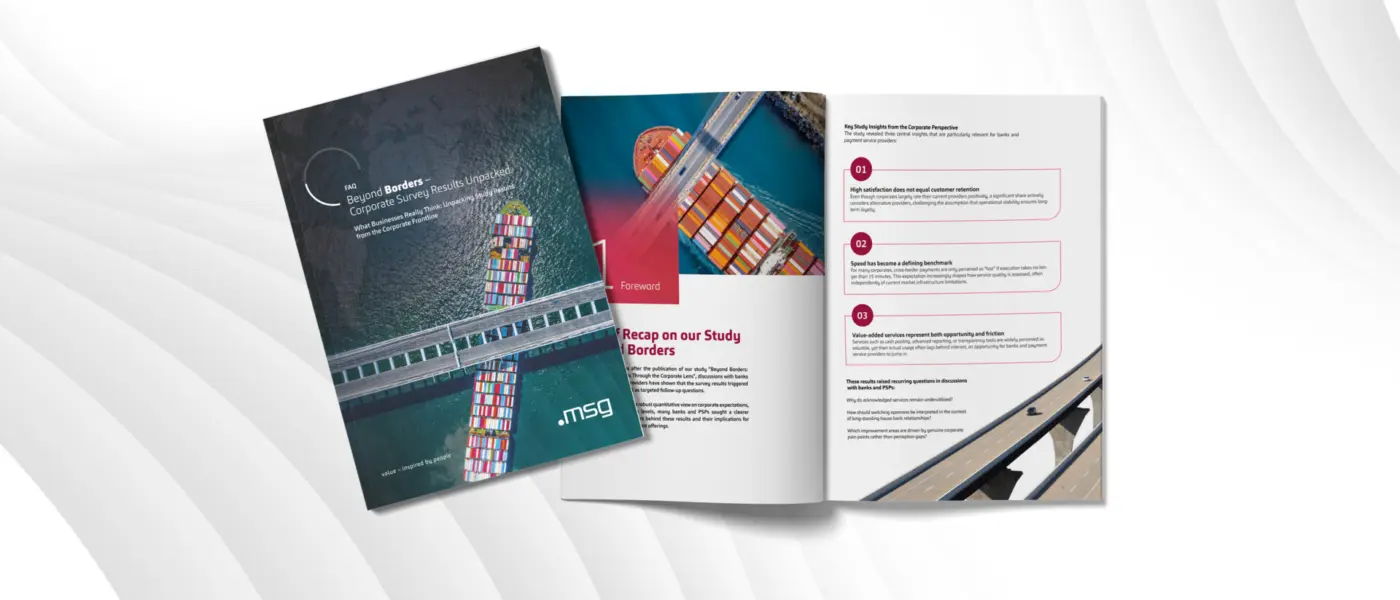
Beyond Borders – Corporate Survey Results Unpacked
What Businesses Really Think: Unpacking Study Results from the Corporate Frontline
This FAQ guide complements the findings of our study “Beyond Borders: Cross-Border Payments Through the Corporate Lens” with qualitative insights gathered from discussions with corporates. It highlights how corporates evaluate current cross-border payment services, where concrete challenges exist, and which expectations banks and PSPs should address going forward.



Included in this collection:
Open collection
E-Invoice 2026+: A requirement for businesses – a strategic opportunity for banks and payment service providers

SEK, DKK, NOK: How ISO 20022 connects Nordic payments to your ERP

The Digital Euro versus Consumer Payments – an unnecessary controversy

Beyond Borders – Corporate Survey Results Unpacked

Instant Payments Regulation: Implementing Reporting Requirements Efficiently – Excel Upload or an Integrated Reporting Solution?

Another step toward implementation: The ECB’s digital euro pilot program launches
FiDA and Open Finance: When data becomes a competitive advantage

DTAZV will be phased out in November 2026 – here's what Corporates and SAP Customers need to prepare for now

The digital euro in everyday payments

Wero 2025/2026 – The European payment engine is picking up speed

Cross-Border Payments from the Corporate Perspective
Discover how corporates evaluate current cross-border payment services, where expectations diverge from perceived delivery, and which fields of action emerge for banks and payment service providers.

Table of Contents
// Foreword
// FAQ
- Cash Pooling: What are the advantages and why is there uncaptured market share in usage?
- Electronic Bank Account Management (eBAM): Do statements such as a camt.086 provide sufficient added value?
- Compliance and Fraud Prevention: What is expected from PSPs compared to corporate obligations?
- EBICS: An alternative to Swift of relevance?
- Service: What does really count when it comes to service levels?
- Willingness to switch: What could be root causes for the identified openness by corporates to consider switching their providers?
- Speed: Is it really a key factor?
- Future solutions: What is the corporate view on the preferred solutions identified?
// Way Forward
Excerpt
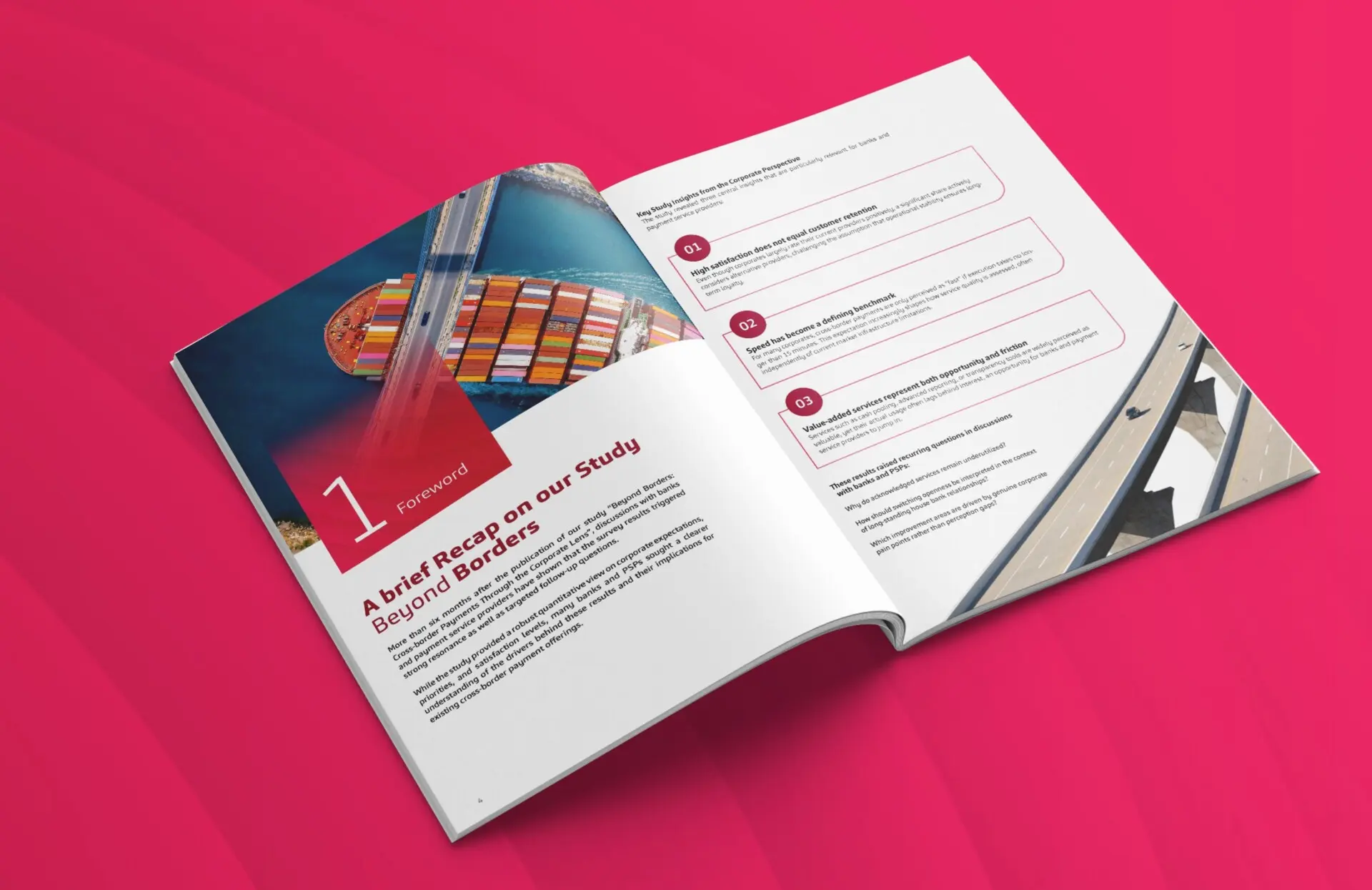
Brief Recap: Key Study Insights from the Corporate Perspective
More than six months after the publication of our study “Beyond Borders: Cross-border Payments Through the Corporate Lens”, discussions with banks and payment service providers have shown that the survey results triggered strong resonance as well as targeted follow-up questions.
While the study provided a robust quantitative view on corporate expectations, priorities, and satisfaction levels, many banks and PSPs sought a clearer understanding of the drivers behind these results and their implications for existing cross-border payment offerings.
Key Study Insights from the Corporate Perspective
The study revealed three central insights that are particularly relevant for banks and payment service providers:
- High satisfaction does not equal customer retention
Even though corporates largely rate their current providers positively, a significant share actively considers alternative providers, challenging the assumption that operational stability ensures long-term loyalty. - Speed has become a defining benchmark
For many corporates, cross-border payments are only perceived as “fast” if execution takes no longer than 15 minutes. This expectation increasingly shapes how service quality is assessed, often independently of current market infrastructure limitations. - Value-added services represent both opportunity and friction
Services such as cash pooling, advanced reporting, or transparency tools are widely perceived as valuable, yet their actual usage often lags behind interest, an opportunity for banks and payment service providers to jump in.
These results raised recurring questions in discussions with banks and PSPs:
- Why do acknowledged services remain underutilized?
- How should switching openness be interpreted in the context of long-standing house bank relationships?
- Which improvement areas are driven by genuine corporate pain points rather than perception gaps?
From Study Results to Practical Interpretation
To address these questions, we conducted follow-up conversations with our corporate clients. The objective was not to reassess the survey results, but to add qualitative context and operational perspective to the quantitative findings.
FAQ
The following Frequently Asked Questions (FAQs) summarize insights from these exchanges. They reflect recurring topics raised by banks and PSPs when discussing the study results and aim to support a deeper understanding of how corporates interpret current cross-border payment services, where expectations diverge from perceived delivery, and which topics warrant particular attention when shaping future payment strategies.
1. Cash Pooling: What are the advantages and why is there uncaptured market share in usage?
According to corporates, cash pooling is an integral part of the banking services used by multinational companies. It supports the central management of liquidity, simplifies day‑to‑day cash handling, and offers advantages when investing or allocating funds across individual country units. In cross‑border payment contexts, cash pooling is primarily used to enable centralized control over funds held by international subsidiaries.
At the same time, corporates highlighted several reasons why cash pooling is not yet used by all companies, despite the perceived benefits. One main factor mentioned is the high setup and implementation effort, particularly in cross‑border scenarios. Implementing cash pooling structures across jurisdictions can be challenging due to local law requirements and differing national frameworks.
In addition, corporates pointed to ERP‑related adjustments as a relevant barrier…

Download the FAQ Guide Now
Discover how corporates evaluate currentcross-border payment services,which expectations banks and PSPswill need to address, and which strategic fields ofaction emerge from these insights.